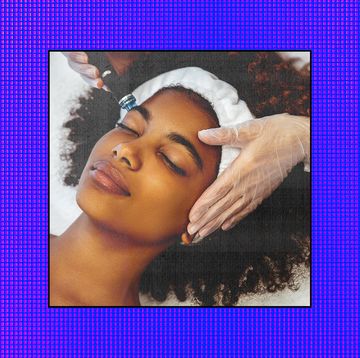
I, like every Sunday night, take up residency in the bathroom. Crossed-legged on the closed-down toilet seat, I get comfortable. The overhead light is unforgiving, all airport and interrogation room – perfect for my close-up skin examination. The extractor fan whirs above me, and on the sink sits my arsenal: stainless-steel pore extractors lined up like surgical instruments, a magnifying mirror that shows me a version of myself I hope no one else has ever seen, and a pile of tissues that will, by the end of the evening, be dotted with tiny spots of blood. I lean it.
I poke; I prod; I squeeze; I scrape. Then, I rinse and repeat these steps until my face is hot to the touch and flushed a furious pink. The soreness feels earned, almost virtuous, as though the pain is proof that something productive has taken place. "Beauty is pain," I tell myself. Next comes exfoliation, a double cleanse, toner, and moisturiser. Finally, I smooth on tretinoin. Done.
Only now, two years on, do I have a name for what I was doing: "Cosmeticorexia".
Although the disorder had previously been referenced in public discourse under the name "dermorexia", it gained significant media attention earlier this year after dermatologist Dr Giovanni Damiani and clinical psychologist Alberto Stefana published a report in the National Library of Medicine.
In their research, the pair began studying the phenomenon of "cosmeticorexia" scientifically, attempting to describe its characteristics, boundaries, and clinical implications. They describe it as an obsessive preoccupation with the skin, characterised by compulsive routines and the persistent feeling that one more serum, one more treatment, one more tweak might finally deliver the face you've been promised. The one in the ads. The one in the marketing campaigns. The one in the TikTok videos.
"The phenomenon is intensified by the medicalization of beauty, the growth of "cosmeceutical" markets, and social media platforms that reward routine-based content and appearance-focused self-presentation," the report reads.
Everyone's clicking on...
"Emerging signals indicate that exposure and uptake are happening at increasingly younger ages, raising concerns about irritant and allergic contact dermatitis, skin barrier disruption, and the reinforcement of maladaptive appearance monitoring and compulsive grooming behaviors."


The media reports that have followed, understandably, focus on children; ten-year-olds asking for anti-ageing creams. And of course, this is alarming. Social media has turned beauty into both a pastime and a pedagogy, while skincare cosmetics brands have quietly lowered their sights to a frighteningly young demographic.
Now, it is important to note that at this stage, being such a recent phenomenon, cosmeticorexia is not recognised as a formal diagnosis in current classification systems. It is therefore difficult to know if there are any potential long-term psychological impacts. But speaking from personal experience of persistent appearance-monitoring and compulsive grooming behaviours, I know this much: they don't simply disappear with age.
The girls buying retinol before puberty do not simply wake up one day cured of the need to perfect themselves. They become women. Women, like me, who know exactly where the magnifying mirror lives.
Keir Starmer's recently proposed social media ban for under-16s may help in some capacity. The exposure to an algorithm perpetuating the idea that your face is a project in need of constant improvement has simply been removed. But it is difficult to believe we can simply age-gate our way out of this. And that's because cosmeticorexia doesn't live solely on social media.
So, unless we're willing to hold platforms accountable for the beauty content they relentlessly serve to all users – and perhaps more importantly, unless we ask far harder questions of an industry that increasingly markets anti-ageing products to children and trades in the language of correction, prevention, and flawlessness – we are only treating the symptom.
Cosmeticorexia may begin in adolescence, but it doesn't end there. It follows you into adulthood, unpacking itself in your bathroom cabinet, settling beside your sink, becoming so ordinary that you mistake compulsion for self-care. And unless we ask why so many women feel compelled to manage, correct and improve their faces, we're not addressing the root of the problem. We're simply watching a new generation inherit it.
Follow Lia on Instagram.
Lia Mappoura (she/her) is the Beauty Writer at Cosmopolitan UK, with over four years of experience reporting across the brand's print, social, video and digital platforms. Lia covers everything from emerging trend analysis to viral celebrity hair and makeup moments, making her an expert at spotting the season’s next big beauty look (before it takes over social media feeds).
In 2025, she was named The Rising Media Star at the Love Perfume Awards with The Perfume Shop, recognised for her outstanding digital fragrance content and for building genuine authority within the space. She is passionate about challenging outdated beauty stereotypes, championing inclusive representation in beauty, and educating readers on the trends, products and conversations shaping the industry today. Follow her on Instagram or find her on LinkedIn.