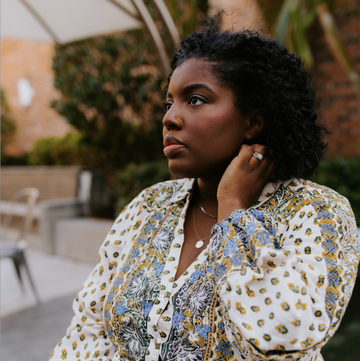
I never planned on the Oura Ring 5 becoming essential to major surgery recovery. But six weeks ago, three days after a myomectomy, I put it on and it quickly became as indispensable as the wedge pillow I now can't live without.
Convalescence isn't something I'm naturally good at – I don't rest well. So having a ring that could tell me, in clear numbers, when I was actually recovering versus when I was just lying still while quietly panicking about work and planning a wedding – that changed how I understand wellness.
Haven't heard of it? The Oura Ring is the cutting edge of health tracking and biometrics, disguised as a simple piece of jewellery. Inside the band, a set of sensors reads your sleep, activity, stress, temperature and more, translating all of it into insights you can actually act on.
Jump to:
Shop the Oura Ring 5

Oura Ring 5 Gold

Oura Ring 5 Brushed Silver

Oura Ring 5 Stealth

Oura Ring 5 Deep Rose

Oura Ring 5 Silver

Oura Ring 5 Black
Oura Ring 5 vs Gen 4: What's changed?
The headline change is size — Oura's calling the Ring 5 the world's smallest smart ring, 40% smaller by volume than the Gen 4, down from 2.88mm to 2.28mm thick and as light as 2g. I wore the Gen 4 for a year, and the difference is immediate: it sits like an actual ring, not tech I happen to be wearing. Two new finishes join the lineup too — a lighter redesigned Gold and a copper-toned Deep Rose.
It's tougher, too. My Gen 4 scratched more than I'd like on a £399 purchase — the Ring 5's new coating is Oura's most durable yet, and mine still looks new after six weeks. Battery life is up from 5–8 days to 6–9, still waterproof to 100m.
In terms of the tech, 12 signal pathways (up from fewer on Gen 4) and more powerful LEDs mean more accurate readings across skin tones, plus sharper auto-detection for low-motion workouts like Pilates. There's also real-time Live Activity Tracking for pace, distance and heart rate mid-run.
The bigger story for me is women's health. Oura's launched Menopause Insights, a proper clinical scale tracking how perimenopause affects sleep, mood and daily life; a Hormonal Birth Control feature that adapts Cycle Insights to your contraception; and Lab Uploads, so you can sit blood work next to your biometrics. I'm not perimenopausal or on hormonal birth control, but it's the first time this ring has felt built around every stage of a woman's health, not just cycle tracking.
Smaller but useful: Data Deletion (wipe a specific time window without losing your account) and one-touch multiring support — both rolling out to Gen 3 onward too.
The core ecosystem — sleep, readiness, activity, stress, cycle tracking — works the same across both rings.
How Sleep Debt got me through the worst jet lag of my life


I flew back from Jamaica mid-recovery, which is its own kind of chaos, and landed with the kind of jet lag that makes 3pm feel like 3am. The Sleep Debt feature — which tracks how far short you're falling of what your body actually needs, not just how many hours you clocked — told me exactly how deep a hole I was in: 9.5 hours of debt, sat there in plain text every morning.
What I liked was that it didn't tell me to fix it overnight. It's not built for a dramatic catch-up sleep; it's built for consistency. Over two weeks, I added small amounts of extra sleep most nights, and watched the number tick down — 9.5, then 7, then 4, then none. Going from a heavily jet-lagged, post-op mess to a sleep debt of zero over a fortnight, just by protecting slightly earlier bedtimes, is the kind of proof I needed to actually stick with it.
Readiness and stress: finding my actual triggers


I assumed my biggest stress triggers would be the obvious ones — public speaking, a packed tube carriage during recovery when I could least afford to be knocked. Instead, the Daytime Stress feature, which tracks your body between Restored, Relaxed, Engaged and Stressed states, kept flagging the same twenty-minute window: right before I left the house.
Every time, like clockwork, that was my most stressed stretch of the day — me convinced I was forgetting something, doing the pre-leaving-the-house sprint around my own flat, certain I was about to be late.
Once I saw the pattern on repeat, I couldn't unsee it. I've started giving myself more time than I think I need before I leave anywhere, and it's the single biggest change this ring has made to my actual daily life.
It's also made me think differently about stress in London generally. Living centrally, there genuinely aren't many places to put stress down — a walk, a fitness class, maybe meditation if the city's pace allows it, and even the parks can feel like borrowed land when you're lying in the grass wondering if you're allowed to be there. Seeing my Restored versus Stressed time in hard numbers has made me more deliberate about carving out that recovery time, rather than assuming I'll get to it eventually.
Staying mobile: activity tracking post-surgery


The enhanced sensors on the Gen 5 turned out to be more useful for recovery than I expected. Coming back from sick leave to eight straight hours in front of a screen was never going to be gentle on a body that had just had abdominal surgery, and the ring's activity nudges got me up and stretching my legs in a way I wouldn't have bothered with on my own. It did the same job on the flight home — reminding me to stay mobile so I wasn't sat still long enough to risk DVT, which is a real concern after this kind of surgery.
Cycle tracking: what I'm watching next
I haven't had my first post-surgery period yet, so I can't report back on this properly — but I can't believe I'm kind of looking forward to it. The Oura Ring tracks your temperature daily to chart where you are in your cycle, and after a myomectomy, I'm curious to see what my body's version of "normal" looks like as it finds its equilibrium again. I'll update this section once I have real data to share.
How much does the Oura Ring 5 cost?
The Oura Ring 5 starts at £399 for Silver or Black, rising to £499 for Brushed Silver, Gold, Stealth or the new Deep Rose. You'll also need an Oura Membership to unlock full insights, at £5.99 a month or £69.99 a year — the same subscription structure as the Gen 4. There's also an optional £99 wireless charging case, which is a nice touch if you're tired of fiddly cables.

Pros and cons
Pros
- Noticeably smaller and lighter than the Gen 4
- More scratch-resistant finish
- Longer battery life
- Sleep Debt makes jet lag genuinely manageable
- Daytime Stress tracking surfaced a trigger I'd never have identified myself
- Same software ecosystem as Gen 4, so nothing is gatekept behind the new hardware
Cons
- Price increase over the Gen 4
- Monthly membership still required for full insights
- Charging case is a separate cost
Kara Kia is the Ecommerce Editor for Women's Lifestyle at Hearst UK, leading Cosmopolitan UK's digital shopping strategy across fashion, beauty and lifestyle. With over eight years of experience as a journalist and editor, Kara specialises in skincare, makeup, haircare and helping women find their personal style — trying and testing every product she recommends. A trusted voice in fashion and beauty ecommerce, Kara's most-read guides include the best wedding dresses under £1000, the best affordable jewellery brands, the best Korean skincare products, and the best products for curly hair. She also covers major shopping events including Black Friday and Amazon Prime Day for Cosmopolitan, Red and Prima. Kara previously held the role of contributing Fashion and Beauty Ecommerce Editor at ELLE UK and Harper's Bazaar UK; before joining Hearst, she was Fashion Content Editor at NET-A-PORTER's Porter Magazine, Associate Editor at PopSugar, and wrote for Refinery29 and LOVE Magazine. An experienced interviewer, she has spoken to Zendaya, Alicia Keys, Simone Biles and Tyla about life, work and style. Born and raised in Kingston, Jamaica and formerly based in Toronto, Kara now lives in London. Follow Kara on Instagram @kara.kia