The 2024 Olympic Games are coming up—and the cultural event is making its way to Paris. This also means you’re about to develop a passionate and sudden interest in surfing and briefly wonder to yourself if it’s too late to launch a career as a professional gymnast (it is, and I'm truly sorry we all can't be the legend that is Simone Biles).
Obviously, the Summer Olympics come around only once every four years, so this is a huge deal that athletes have worked toward their entire lives. And due to countless hours spent training and little time to earn an income outside of said training, one would *hope* Olympians get paid the big bucks. Long story short: they do! It's a pretty complicated process, so we broke it all down for ya so you don't miss a beat.
Does the Olympic Committee Pay Athletes?
The International Olympic Committee does not give out money for participating in the Games nor does it give out money for winning gold, silver, or bronze medals. However, there are these things called “Olympic medal bonuses,” which are monetary prizes awarded to Olympians by the countries they represent. So basically, if you win, your home country will fork over some congratulatory money.

How Much Does the U.S. Give in Olympic Medal Bonuses?
Per a 2021 report by NBC, the U.S. Olympic & Paralympic Committee offers "Operation Gold" payments for U.S. Olympic winners. Long story short, winners get $37,500 for winning gold, $22,500 for winning silver, and $15,000 for winning bronze. And that’s the amount an athlete earns for each medal—so let’s say you win two gold medals plus a bronze. Your total earnings would be $90,000. According to KSAT, the Olympian who earned the most from the 2020 Tokyo Games was swimmer Caeleb Dressel, who won five gold medals and made $187,500.
And FYI, this money is *not* taxed, meaning it’s not considered earned income by the U.S. government and Olympians who win medals walk away with alllll of their bonus money. Of course, not every person competing in the Olympics wins a medal, which means plenty of people walk away without bonuses.
Note: Some countries pay more in medal bonuses than the U.S. USA Today recently contacted the national Olympic committees of 40 different countries (!!!) to ask about their medal payouts. On average, 25 respondents revealed that they'll pay athletes the equivalent of $95,000 for gold, $55,000 for silver, and $39,000 for bronze in their respective currencies.
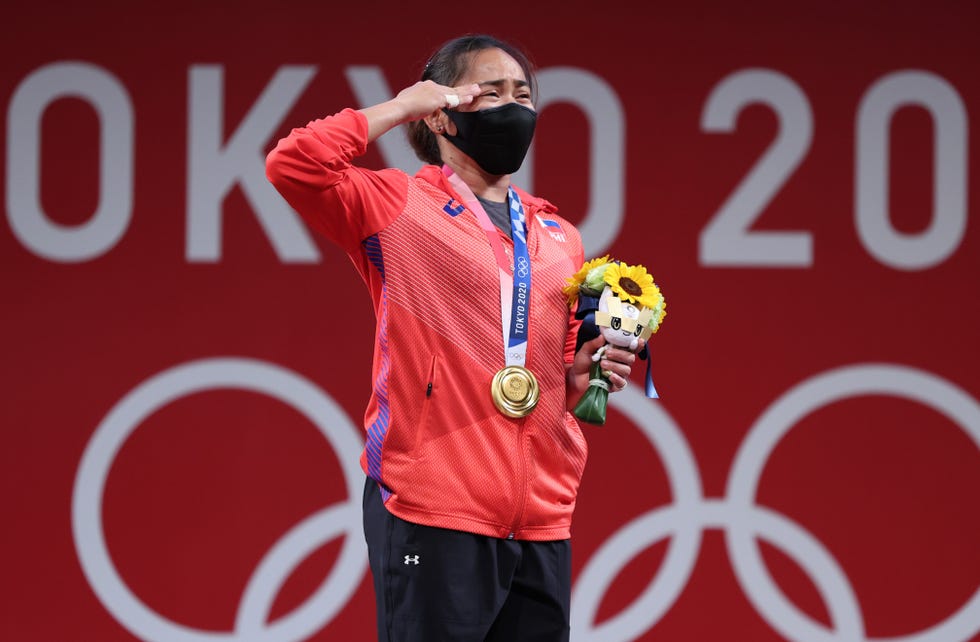
According to CNBC, Singapore is the most generous to its athletes and gives gold medal winners 1 million Singaporean dollars (or $750,000 USD). The Philippines also pays a lot to its winners. During the 2020 Tokyo Olympics, weight lifter Hidilyn Diaz got $200,000 for winning the country’s first gold medal plus additional compensation that brought her total earnings to $970,000 (and she was given a house, a condo, and unlimited flights!).
What About Sponsorships?
Sponsorships are obviously a major way that athletes—more specifically, celebrity athletes—can make money. But not every athlete who makes it to the Olympics becomes famous enough to score lucrative sponsorship deals. According to a COVID-19 impact survey from 2020, more than half of Olympic hopefuls made less than $25,000 in the year they competed.
“On the whole, most of the athletes are not salaried,” Tim Baghurst, PhD, head of the Interdisciplinary Center for Athletic Coaching at Florida State University, told WUSA9 in 2021. “They don’t get paid to go to the Olympics. They’ll have their travel covered, lodging covered, and food covered. Outside of the major sports, and those athletes that have high profiles, a lot of these athletes really struggle financially. A lot of them have part-time drop jobs and it’s only in the Olympics where we really, really see them shine.”
Meanwhile, big names can make millions. Majorly famous Olympic athletes like Simone Biles and Naomi Osaka both earn millions of dollars per year in part through sponsorships, so yeah—a person can make a *lot* as an Olympian. But…what if you’re not Simone or Naomi levels of famous? Athletes who don’t make a ton in sponsorships can apply for grants that support their training, so at least there’s that!