

Jump to:
- What is the ADF and how is it linked to Nigel Farage?
- What do buffer zones and free speech have to do with it?
- Following the money trail
- Nigel Farage’s stance on abortion
- Reform UK: where does the party stand?
- Given that Reform UK is repeatedly leading in voting intention polls, is this American-inspired rights removal – that the party seems to happily back – actually working?
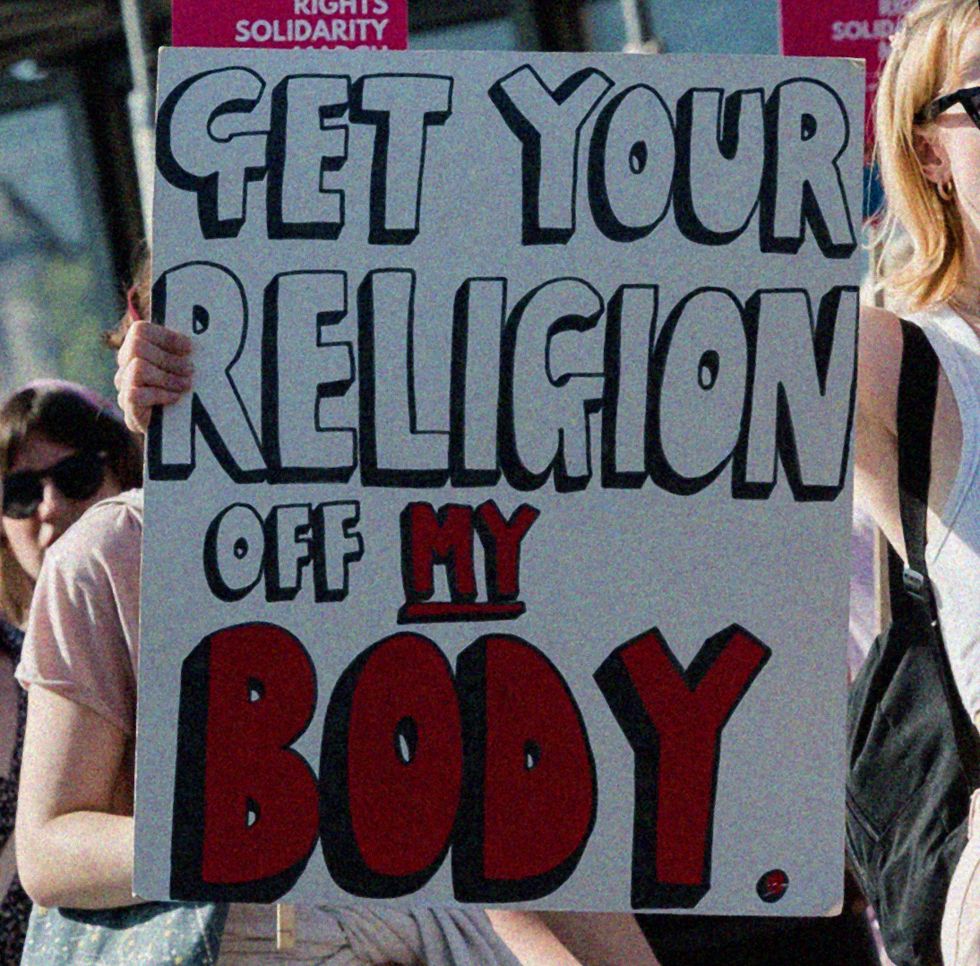
There’s been a lot of talk recently suggesting that we need to keep a close eye on abortion rights here in the UK. With whisperings that what happened in America – the toppling of Roe v Wade, which left a 10-year-old denied an abortion – could happen here, especially if Nigel Farage’s Reform UK party makes it into power at the next election.
While nothing is guaranteed, it’s a scary thought – particularly as we made great strides with abortion care this year.
MPs recently voted to decriminalise abortion in England and Wales. The move followed a long-running campaign by the country’s leading abortion providers, BPAS and MSI, and more than 30 other organisations, including Women’s Aid and Royal College of Obstetricians and Gynaecologists, with backing from Cosmopolitan UK.
Data shows that 52% of Brits believe those who have an abortion outside of the legal time frame – something that happens rarely and when it does, involves highly vulnerable women – should be dealt with compassionately, as opposed to through the justice system.
But, despite this bold step forward, along with widespread government and public support (87% back the right to an abortion in the UK), it seems that Reform UK is veering off in the opposite direction when it comes to women’s rights. The party stands accused by concerned MPs and feminist activists of buddying up with hard right, Christian nationalist groups from the United States – intent on stripping abortion access here in the UK.
Reform UK’s leader, Nigel Farage, seems to have forged deep-running ties with one organisation in particular, the Alliance Defending Freedom, that is now on a mission to roll back British abortion rights, after succeeding in America.
Everyone's clicking on...
So, what are these links? And what has Nigel Farage actually said about abortion? Should we be worried that, if the party were to come into power one day, our rights would be reversed?
We contacted experts in the field and all the major political parties in the UK, to find out the score.
What is the ADF and how is it linked to Nigel Farage?
The many apparent links between Farage and the globally-reaching Alliance Defending Freedom International were outlined in a recent New York Times article, which alleges multiple meetings have taken place. The organisation says it promotes “religious freedom”, “free speech” and “the sanctity of life” – often via campaigns against abortion access and LGBTQ+ rights. The ADF is also credited with spearheading the crusade to overturn Roe v Wade in the US, leaving some states with no abortion access whatsoever.


The NYT’s report detailed how Farage’s personal links to Alliance Defending Freedom include giving evidence to a US House Judiciary Committee event in September 2025, reportedly arranged with help from the ADF’s UK branch. While there, he branded the UK as “awful” and compared citizen rights to that of North Korea.
Many of the ADF’s alumni now work for the Trump (someone Farage once described as “the bravest man” he knows) administration.
What do buffer zones and free speech have to do with it?
Farage was championed by the ADF for condemning UK abortion clinic buffer zones, which prevent protesters from praying within 150m of a clinic or shouting “murderer” or “mum” to women seeking a termination, labelling the zones “a crackdown on free expression.”
The ADF has recently provided legal aid for those found breaching the UK’s abortion buffer zone rules too. It’s a sneaky tactic used by the group – claiming that the newly-implemented ban is an impingement on “free speech rights”, rather than just outwardly stating its ultimate goal: to close all abortion providers. Anti-abortion groups know that the UK is mostly pro-abortion rights and that they cannot win by out and out calling to shut services down.
Far right figureheads, like Elon Musk and Tommy Robinson, have also been wading in on the ‘free speech’ debate, attempting to paint the UK as a country where nobody is ‘allowed to say anything anymore’, rather than discussing the nuanced differences between free speech and hate speech, or harassment.
The US Vice President, JD Vance, raised the British abortion and free speech issue at the Munich Security Conference back in February, claiming that the UK has “placed the basic liberties of religious Britons [...] in the crosshairs” with the buffer zone implementation, in reference to the conviction of Adam Smith-Connor, who ignored multiple police requests to move away from a BPAS clinic in Bournemouth.

Smith-Connor claimed he was merely praying for his ‘unborn son’ who ‘died from abortion 22 years ago’, as opposed to deliberately trying to upset women on their way into the clinic during an already difficult time.
When I interviewed one religious clinic lurker, who is part of another Christian-affiliated group, 40 Days for Life, prior to the buffer zone ban coming into play, he told me he was “unashamed” in his goal being to close the clinic we were standing opposite. He said abortion should be banned even in cases of rape or incest, stating “it can’t be justified under any grounds”.
The man added, “We don't want to break the law, but we'd have to find a way around the buffer zone if it does get implemented.”
Following the money trail
As for what ‘finding a way around a buffer zone’ looks like, there’s since been a major ramping up in anti-rights spending on British soil: between 2019 and 2023, anti-abortion groups in the UK spent a combined £106 million (a rise of 33%).
In particular, the ADF’s UK branch has more than doubled its spending from £390,000 in 2020 to £770,000 in 2022 – and reported an income of £1.3 million the following year.
It’s thought that, without being able to physically stand outside and torment women going in for a termination, one of the ways groups are spreading their messaging is through crisis ‘pregnancy centres.’
Almost a third of these centres have been accused of spreading misleading medical information, unethical advice or both (as per a BBC Panorama investigation), including claiming that having an abortion leads to a higher risk of cancer. Said centres also saw funding surge by 46%, underlining how US-style lobbying is increasingly being bankrolled on British soil.
Speaking about groups like the ADF and the US’ anti-abortion rhetoric more generally, Liberal Democrats’ Deputy Leader, Daisy Cooper MP, told Cosmopolitan UK, “I won't be the only woman absolutely horrified to learn that Nigel Farage is seemingly colluding with the Trump administration to set women's rights in Britain back decades.
"Parts of Trump’s America are becoming an increasingly hostile and dangerous place for women. We can’t let Farage make that the norm here at home. He needs to come clean about his meetings with this group who are openly trying to rip up our hard-won right to choose and access safe, essential reproductive healthcare."
Nigel Farage’s stance on abortion
When Farage was asked by the New York Times about his relationship with the ADF, he said his party talks with “all sorts of groups” and denied speaking against abortion, telling a reporter that she was “talking utter b*llocks”. He said that abortion was “number 468” on Reform UK’s agenda and noted he had “hardly ever spoken about it in 30 years”.
But, in May this year, Farage’s questionable abortion stance arguably began to show. “I am pro choice,” he said. “But I think it’s ludicrous, utterly ludicrous that we allow abortion up to 24 weeks.” 90% of abortions occur before 10-weeks, and of the tiny percentage of those who do present at 22 to 24 weeks (and who are not having an abortion due to medical reasons) are incredibly vulnerable.
Reducing the time-limit to 22 weeks, all experts who work in the field agree, would target these women, forcing them to continue a pregnancy that could put their life at risk.


Previously, an ADF spokesperson, Paul Sapper, claimed his group is “non-politically partisan” and has “engaged with every major political party in the UK”. Yet, when asked by Cosmopolitan UK if they’d ever engaged with the ADF, the Liberal Democrats, Green Party, Scottish National Party and Plaid Cymru all said they had not.
The Conservatives, Reform UK and Labour did not respond, but the latter has previously gone on record elsewhere to say it has had no contact with the ADF.
When Cosmopolitan UK presented the ADF with this discrepancy, that five leading parties have all denied liaising with them, Sapper, the spokesman who is also quoted in the NYT piece, said, "ADF International has engaged with parliamentarians from every major Westminster political party on our work."
His email added, “We will be making no further comment.”
Reform UK: where does the party stand?
Further clues that his party are not as ‘pro-choice’ as Farage says, include the fact that, when asked earlier this year about the amendment that would see abortion removed from criminal law, all of Reform UK’s MP’s voted against it. They have also welcomed 15 Tory party defectors, all of whom have tried to roll back abortion rights in some capacity.
One, Danny Kruger, even declared in Parliament following Roe v Wade being ousted that women do not have an “absolute right to bodily autonomy”. Another, Nadine Dorries, best known for being a staunch defender of former Prime Minister Boris Johnson during the pandemic #partygate mess, repeatedly sought to slash the UK’s 24-week abortion limit and introduce mandatory ‘independent’ counselling for women considering the procedure. Efforts which, thankfully, were defeated by large majorities in the House of Commons.
In October, Reform UK also appointed Professor James Orr as a senior adviser. Orr is a theologian who has previously worked within Trump’s administration, and who is known for his hardline stance on abortion, opposing it even in cases of rape, incest, or if there’s a serious risk to health.
Earlier this year, amid the successful End 1861 campaign, supported by Cosmopolitan UK, to remove abortion from criminal law, Orr labelled Britain’s current abortion laws as “one of the most extreme abortion regimes in the world” in response to an interview with an MP on the topic of stopping the prosecution of those who have a termination outside of the 24-week limit, offering them medical and mental health support instead.
Some anti-choice groups have flipped this sentiment into blatant misinformation, claiming the campaign was designed to allow abortion to be legal up until birth – in spite of all the medical colleges involved repeatedly stating the 24-week limit would still be adhered to within a healthcare setting.
This categorically false argument – that those championing women’s rights are pushing to legalise abortion up until birth – is often put forward by the anti-abortion brigade in an effort to mislead the public about the debate. To be clear: none of the leading abortion care providers feel the time limit should change.
Elsewhere, Orr has been described as JD Vance’s “intellectual mentor”. (A reminder: when asked if abortion laws should include rape and incest exceptions, the Vice President replied, “Two wrongs don't make a right. At the end of day we are talking about an unborn baby. [Do we want] a society that looks at unborn babies as inconveniences to be discarded?”)
Given that Reform UK is repeatedly leading in voting intention polls, is this American-inspired rights removal – that the party seems to happily back – actually working?
Thankfully, according to a new report by NatCen Social Research, UK and US attitudes: Two Sides of the Same Coin?, it seems not. At least, not yet.
The research found that Britain is notably more progressive than the US when it comes to women’s rights and reproductive freedom and according to the data, 86% of Britons believe abortion should be legal in all or most cases, compared with just 63% of Americans – a stark reminder that, while reproductive rights remain politically fraught in the US, the UK public largely sees abortion as a settled issue of healthcare and autonomy.
The study also highlights that although both countries are wrestling with polarisation, the flashpoints differ: in the US, abortion and LGBTQ+ rights dominate culture wars, while in the UK, division currently tends to centre more on immigration and national identity.
Louise McCudden, MSI Reproductive Choices' UK head of advocacy told Cosmopolitan UK: “Most people in the UK are pro-choice and so are most MPs. However, with the US-led anti-abortion movement funnelling over a million pounds a year into the UK, and with Reform UK’s leader, Nigel Farage, making comments that threaten the consensus on abortion access, it's no time to be complacent.
“We encourage politicians of all political parties to listen to their own constituents, and to the one in three women who has an abortion at some point in her life, not the small but very vocal minority of extremists who ultimately want to take away the right to do so.”
McCudden added that she remains positive despite the growing backdrop of backlash, “In recent years, MPs across all major parties have voted to stop prosecuting people for ending their own pregnancies, to ban harassment of women outside abortion clinics, and to make at-home abortion care legal.
“The anti-abortion movement threw everything it had at opposing these popular reforms, but MPs rightly listened to women instead.”
Still, as Reform UK’s rise to popularity prompts renewed scrutiny of women’s rights at home, the findings serve as a timely warning that cultural currents can and do shift – and public support, however strong, is no guarantee of lasting protection.
So, if this is an issue that worries you, make sure you keep on-top of what the party actually stands for and, of course, turn out to vote against them when the time comes. We can’t let them win.
Jennifer Savin is Cosmopolitan UK's multiple award-winning Features Editor, who was crowned Digital Journalist of the Year for her work tackling the issues most important to young women. She regularly covers breaking news, cultural trends, health, the royals and more, using her esteemed connections to access the best experts along the way. She's grilled everyone from high-profile politicians to A-list celebrities, and has sensitively interviewed hundreds of people about their real life stories. In addition to this, Jennifer is widely known for her own undercover investigations and campaign work, which includes successfully petitioning the government for change around topics like abortion rights and image-based sexual abuse. Jennifer is also a published author, documentary consultant (helping to create BBC’s Deepfake Porn: Could You Be Next?) and a patron for Y.E.S. (a youth services charity). Alongside Cosmopolitan, Jennifer has written for The Times, Women’s Health, ELLE and numerous other publications, appeared on podcasts, and spoken on (and hosted) panels for the Women of the World Festival, the University of Manchester and more. In her spare time, Jennifer is a big fan of lipstick, leopard print and over-ordering at dinner. Follow Jennifer on Instagram, X or LinkedIn.


