
When you think about abortion rights, maybe you tend to think about the US rather than the UK. (At least since the successful decriminalisation of abortion in the north of Ireland in 2019.) State-wide abortion bans. The overturning of Roe v Wade. Stuff that’s unsettling, sure, but far away.
But ours is a globalised world. With cultural and political winds blowing eastward from the US. And much as obsessions over Sabrina Carpenter’s innuendo use and whatever Hailey Bieber is putting on her skin resonate either side of the Atlantic, the US anti-choice movement - abundantly funded and emboldened by an emphatically-won second Trump term - appears to be seeking to deepen its reach within the UK.
US religious organisations are funnelling cash into anti-abortion groups in the UK and Europe - some $50m of funding from 12 influential Christian rightwing US foundations in the US, per 2019 OpenDemocracy research. While reproductive rights experts have observed a 'creeping expansion' of anti-abortion Christian nationalist groups in the UK since 2013.
Here in Britain, while abortion is legal up to 24 weeks (if signed off by two doctors) and is generally safe and accessible for most, it still technically remains a criminal offence under the 1861 Offences Against the Persons Act. A Victorian era law put in place decades before women even had the right to vote.
Over the past two years, six women have appeared in court under the act - versus only a handful of known convictions since the law was implemented over 150 years ago.
Now, one US anti-abortion organisation, Alliance Defending Freedom, in particular is expanding its campaign in the UK – and wading in on a case playing out in Bournemouth this week.
ADF UK, which says it advocates for “the right of Christians and others to freely associate and share their faith in public”, has played a significant role in lobbying against the introduction of buffer zones around reproductive health clinics.
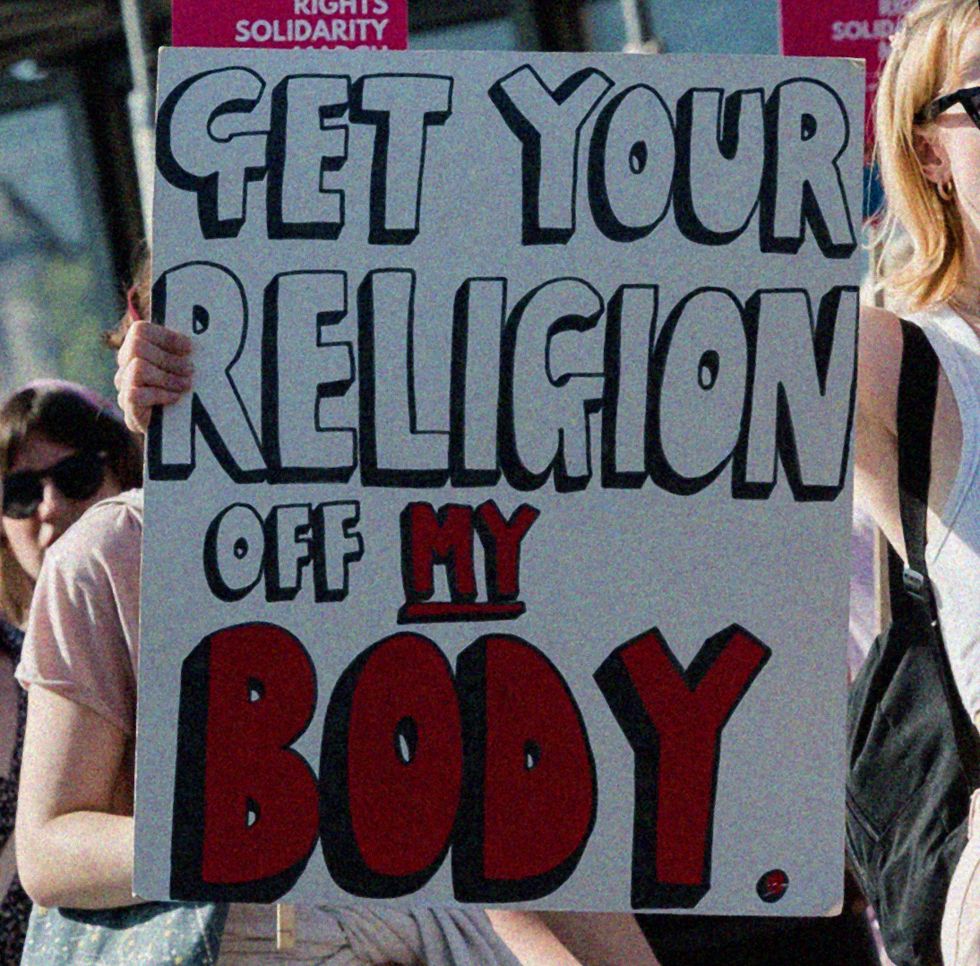

These buffer zones were put in place after women seeking an abortion and clinic staff reported being routinely harassed by anti-abortion campaigners. Cosmopolitan's previous reporting has revealed that campaigners shout 'mum' or 'murderer' at the women in an effort to guilt trip them, hold up graphic signs with alarming medical misinformation, and have even been known to block (or try to grab at) those entering clinics.
The ADF is a designated hate group, according to the US Southern Poverty Law Center, and has close links with the White House – and it has shared that they’ve worked with the current administration reversing trans rights.
ADF UK’s income was more than £1.3m last year, per records filed to Companies House and reported by the Guardian.
Its UK branch is now also funding the case of Livia Tossici-Bolt: a retired medical scientist who is being prosecuted for allegedly breaching a buffer zone in Bournemouth. She is also the leader of the Bournemouth branch of 40 Days for Life, a known Christian anti-abortion group that started life in Texas.
When a Cosmopolitan journalist interviewed a Reading member of the group, they said they believe abortion should never be allowed under any circumstances, including in the event of rape.
While Tossici-Bolt was not holding up graphic imagery, she held a sign saying 'Here to talk if you want' and was known to regularly visit the area by the clinic.
While this sign might sound harmless, the rules of abortion buffer zones dictate that nobody is allowed to interfere with a service user (AKA a woman going through the already potentially emotionally-tough experience of having an abortion) and the case against Tossici-Bolt argues that her presence could have still caused distress.
As per the Home Office, people can’t “intentionally or recklessly influences someone’s decision to use abortion services, obstruct them, or cause harassment or distress to someone using or working at these premises.” Part of the buffer zone agreement also forbids anyone from holding 'text or images relating directly or indirectly to the termination of pregnancy'.


However, the case is now of interest to the US government, tied up with its narrative that Britain has a free speech problem - with the Bureau of Democracy, Human Rights and Labour in the US posting on X that the case raised concerns about “freedom of expression within the United Kingdom”.
The post also detailed that a representative met with Ms Tossici-Bolt while in the UK.
“We are monitoring her case,” the post continued. “It is important that the UK respect and protect freedom of expression.”
A verdict on Tossici-Bolt's alleged breach is expected on Friday. She denies the charges.
Her case, a source told Cosmopolitan UK, is set to play out way beyond Bournemouth, and become a lightning rod around which the anti-choice movement in the UK will gather. With significant support from its US wing.
Tossici-Bolt's case follows that of another anti-abortion activist, Adam Smith-Connor, who was convicted for praying outside of the same clinic and refusing requests to move on. His case was cited by the US Vice President JD Vance as another example of free speech being under threat across Europe.
Reproductive healthcare providers in the UK are concerned. With Louise McCudden, UK head of external affairs at MSI Reproductive Choices telling the Guardian: “Before safe access zones were implemented last year, the behaviour we saw outside our clinics included spitting, calling women ‘murderers’ and physically blocking people from entering our clinics.”
An ADF spokesperson told the newspaper that it was a registered human rights charity in the UK and was grateful to the US for bringing attention to what it described as the “free speech crisis” in Britain.
“We advance the right to live and speak the truth for all people and are proud to support Livia’s case and the cases of our other clients who have been victims of ‘buffer zone’ censorship,” they said.
It’s a fraught time for the global conversation about reproductive freedoms and what actually constitutes having your right to 'free speech' blocked. You can count on us to keep you updated about what this means for you in the UK.
Roisín Dervish-O’Kane is Women’s Health’s multi-award-winning Features Director and Chief Interviewer. From her zeitgeist-capturing commissions to profile interviews that spark global media conversations, her journalism gets right to the heart of the biggest talking points across health, society, culture - and their fascinating intersection.
Heading up WH’s industry-leading features offering, she plans, commissions and edits longform features across the site and magazine on everything from why medical sexism leads women to self-diagnose online and the lasting biological harms of emotional self-suppression to whether the booming longevity industry’s claims tally with the research base. She also launched Well Opinionated, the home of incisive, reactive comment on health news, politics and the latest wellness world controversies.
An experienced presenter - she’s hosted The Women’s Health and Intelligence Squared podcasts - you can find her in front of the camera, drawing out the health stories of WH’s cover stars.
Roisín has been named Writer of The Year by the PPA and made their 30 under 30 list. Her writing has also been recognised by the Medical Journalists Association and Guild of Health Writers, while The Women's Health Podcast, which she produced and hosted, earned a highly commended for 'Best Health Podcast' at the Publisher Podcast Awards.
She is also a regular news review contributor on BBC radio, an experienced panel host - and speaker.