If, like us, you've spent the last few days glued to your TV watching The Crown season five, then you've probably got a Google search history full of questions like: 'What happened to the royal yacht?', 'Did Charles really try to overthrow the Queen?' and 'Why was Princess Diana's Panorama interview so controversial?'. It's only natural...
Well, wonder no more, as we've done all the historical digging for you to bring you every fact about The Crown that's been plaguing your mind since the trailer for the fifth season dropped. And today's history lesson? The Queen's 'annus horribilis', which we see her discussing in episode four.
What does 'annus horribilis' mean?
Before we get into what happened during the Queen's 'annus horribilis', let's first understand what it actually means. Annus horribilis is a Latin phrase, meaning "horrible year" and is essentially an antonym of annus mirabilis, which means "wonderful year". The more you know, ey!
When was the Queen's 'annus horribilis'?
In the fourth episode of the upcoming season, we'll see the Queen describe 1992 as her 'annus horribilis' during a speech at Guildhall on 24 November 1992,
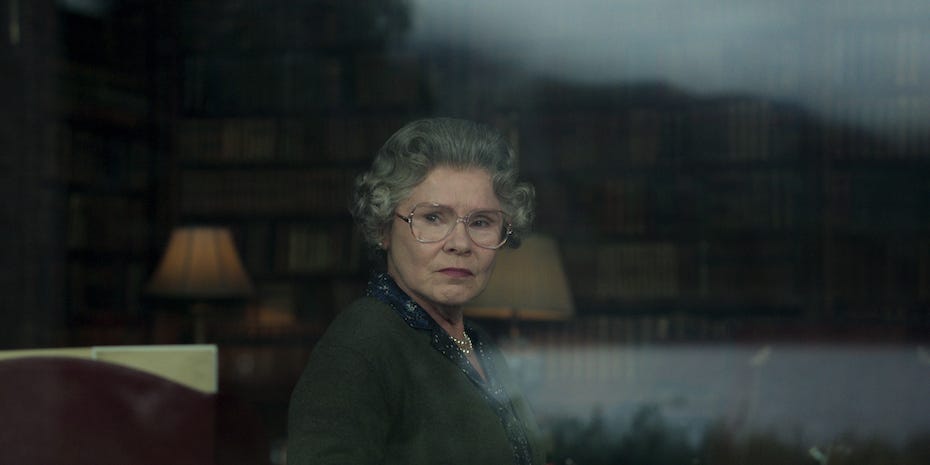

"1992 is not a year on which I shall look back with undiluted pleasure," Her Majesty said. "In the words of one of my more sympathetic correspondents, it has turned out to be an annus horribilis."
What happened during the Queen's 'annus horribilis'?
Now that we've got our Latin all straightened out, let's take a look at what happened during the year that the Queen described as an 'annus horribilis' – although, the better question to ask would be what didn't happen.
During a year that taxpayers increasingly questioned the cost of the Royal Family, the royals experienced several scandals – all of which the Queen was, unsurprisingly, unhappy about. Perhaps most significant was the breakdown of her children's marriages, with three out of four coming to an end: Prince Charles and Princess Diana, Prince Andrew and Sarah Ferguson and Princess Anne and Mark Phillips.
Andrew Morton's somewhat scandalous book about Princess Diana – which she recorded secret tapes for – was also released in 1992, as was the transcript of a phone call between Charles and Camilla Parker Bowles, in which he said he wanted to "live inside" her trousers.
But the monarchy's woes didn't end there. To top it all off, a fire broke out at Her Majesty's beloved Windsor Castle on 20 November. The fire burned for 15 hours and caused about £36.5 million worth of damage, although thankfully, many valuable works of art and furniture were saved from the blaze by a human chain that included palace staff and Prince Andrew.


Amid backlash from the public over the cost of repairs to the historic property, the Queen opened parts of Buckingham Palace to the public for the first time to help raise funds. Her Majesty also volunteered to start paying income tax – a tax the sovereign had been exempt from since 1937. And the Queen didn't stop there, going on to reduce the number of royals whose expenses were paid by parliament.
What did the Queen say about her 'annus horribilis'?
During her speech, the Queen made many references to her 'annus horribilis' and how she would like the monarchy to be seen and treated going forward.
"No institution should expect to be free from the scrutiny of those who give it their loyalty and support, not to mention those who don't," Her Majesty said. "But we are all part of the same fabric of our national society and scrutiny can be just as effective if it is made with a touch of gentleness, good humour and understanding."
Season five of The Crown is available to stream on Netflix from 9 November.