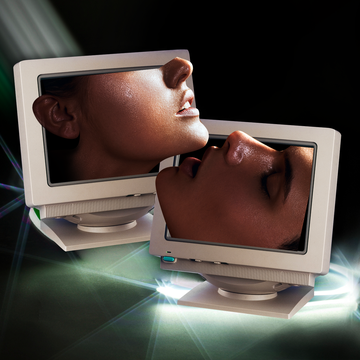
Whether you were having any or not, 2025 was a big year for sex. Over the last 12 months, the landscape of desire was reshaped in ways most of us are still catching up to. We saw age-verification walls appear like tragic little chastity belts across the internet — laws that pushed porn behind locked doors overnight (ostensibly to try and keep out under 18s, but affecting adults, too). Social media tightened the screws on anyone speaking openly about sex. Dating apps continued their slow drift into irrelevancy as more people admitted they were (still) burnt out by endless swipes and dead-end chats. All in all, it’s been a pretty unsexy time.
As the founder of Lover Management, a talent agency specialising in intimacy and the erotic, I’m immersed in the state of sex, desire, sex work, dating, and more, and even I’ve found it hard to keep up with our changing sexual climate. So, where will our romantic lives go in 2026?
At a time of dating app fatigue and growing online censorship, and with our erotic autonomy increasingly shaped by systems completely outside our control, you’d think offline, right? In this future tech-free utopia, we’d get back into offline pornography, meet sexual partners spontaneously in person, and start having more actual sex than virtual sex.
And, while some of this might come true (we hope!), it probably won’t be quite as simple as that. A couple of years ago, something called the ‘Stripper Index’ — a term that emerged via viral social media posts from sex workers — became a cultural pulse check. The idea is simple: how much money people are spending in strip clubs is a leading indicator of economic confidence. When tips are flowing, people feel flush; when they dry up, it often signals financial anxiety before it shows up elsewhere.
This index can also be applied to dating more generally — no money? Less dates — as well as to our prioritisation of physical intimacy in hard economic times. And in 2025, the ‘Stripper Index’ showed that IRL intimacy wasn’t booming in the way you perhaps initially would’ve thought. If anything, it actually painted a picture of a population craving connection — but too tired, too broke, too anxious, and too overstretched to seek it out physically. Desire was shifting, yes, but not in the simple ‘we’re all going out again’ arc you might expect.
That’s not to say sex and dating will cease this year — far from it. But, in such a turbulent time, what exactly will happen to it? According to Tinder’s annual Year in Swipe report, we’re going to be prioritising clarity, confidence, and honest self-expression this year, while Lovehoney predicts that we’ll be seeking out more meaningful connections instead of casual sex.
Now, I’m lucky enough to work with some of the most influential sex educators, dominatrixes, porn directors, intimacy coaches, erotic artists, sex therapists, and relationship innovators in the UK and beyond, who sit at the coalface of modern desire. If anyone can predict what relationships and intimacy will actually look like in 2026, it’s them. And if anyone has a front-row seat to this shift, it’s me. So I asked them one simple question: ‘What will sex and dating look like for women in 2026?’
What follows is a speakerbox of grounded, unexpected predictions about porn, dating, sex parties, intimacy, censorship, and the future of desire — from the people shaping it every day.


Yearning is back, baby
Leanne Yau, AKA Poly Philia, poly educator
“I think we’re going to see a further push to the return to in-person dating. Apps like Breeze — where there’s no chat function and the app simply arranges a date for you — signal a desire for less emotional admin and fewer dead-end conversations. Or the app Thursday’s singles mixers, too. People are tired of the scroll, the ghosting, the unreliability. Apps that promise the opposite will do well in 2026.
I also think many people will deprioritise dating altogether, putting more energy into friendships or things that feel nourishing and reciprocal. I’ve noticed there’s a collective craving for yearning — we’re seeing it in media like Bridgerton, in on-screen rivalries, in will-they-won’t-they tension. It’s a backlash to instant gratification culture.
We’ll likely also see more portrayals of polyamory in mainstream media — but I want to see not just throuples, but metamours, networks, the full range. Good or bad, representation is still representation. At the same time, with the rising popularity of polyamory, I’m noticing people using poly terms like ‘relationship anarchy’ to mask bad behaviour — almost an extension of fuckboy dating. These concepts are easily misunderstood and easily abused.”
High standards will be in
Eva Oh, international dominatrix
“Sex and dating in 2026 may drift toward something slower and more deliberate, simply because people seem exhausted by the noise — the gated porn, the moderation, the endless app admin. I have a sense that desire could become more context-driven again: less about overstimulation, more about voice, tension, and the small psychological signals that make intimacy feel alive. And while dating apps won’t disappear, I imagine they’ll take up less emotional real estate as people look for connections that feel less managed by algorithms. I also wonder if we’ll see sex parties and IRL intimacy spaces become more curated and community-led, partly because people want safety and depth rather than pure spectacle.
If I could give women one thought for 2026, it’s that wanting what you want isn’t unreasonable; standards aren’t a burden, they’re a compass. Overall, when I look at the landscape, I don’t see a culture collapsing — just one rearranging itself around privacy, intention, and the kind of intimacy that can’t be automated.”
We’ll all be striving for meet-cutes
Jessica Stoya, intimacy coach, author, and retired porn star
“What I’m hearing from coaching clients is a consistent yearning to meet people organically and in person, along with a wish for more third spaces which are appropriate for those interactions and a desire to develop the confidence that supports striking up conversations with strangers. This tracks with a general trend I’m seeing in friends and acquaintances away from scrolling and swiping, and towards social mingling. What I believe will differentiate 2026 from the norms of previous years is a much greater concern on the part of men around how to be cautious of the boundaries and comfort of women they’re hoping to talk to while being proactive and making an approach.”
Sex parties will continue to thrive — and grow
Miss Gold, owner of One Night Parties
“Coming out of the past year, the discourse was ‘boyfriends are out of fashion’. As a FLINTA [Female, Lesbian, Intersex, Non-binary, Trans, and Agender] sex party planner and owner, I see women from all walks of life and women are prioritising pleasure, self-worth, and emotional safety more than ever — and they’re being far more discerning about who gets access to them. There’s a growing expectation that intimacy should be held with care, intention, even reverence. Less casual entitlement, more sacred holding which women do so well.
Back in 2019 when we started, there weren’t many spaces that centred femme desire so explicitly — especially spaces that were trans-inclusive or designed for FLINTA people to explore femininity, sexuality, and power on their own terms. Over the past six years, that’s changed dramatically. We’ve seen a rise in sex-positive spaces that are more intentional, more inclusive, and less performative.
From my own experience running One Night Parties, I’ve noticed something interesting. Our social-only events don’t perform as well as those built around play. People want to fuck; and when there’s a structure — games like spin the bottle etc. — intimacy flows more easily. People don’t just want to talk; they want to feel. They want to play. People are craving intimacy that feels new, diverse, and curated.
Looking ahead to 2026, I think parties will become smaller, more intimate, and more varied. I want to see more sober events. More daytime gatherings. More spaces outside London — especially up north. Less spectacle, more connection. People aren’t withdrawing from desire; they’re refining it.”


It’s gonna be ‘the year of the sex freak’
Noelle Perdue, porn historian and writer
“In 2025, we were inundated with ‘tradwife’ influencers and ‘God first’ boys eating raw steaks off Betty Crocker cutting boards. While both have been the subject of ridicule, I think 2026 is when we’ll really start to feel how much of an impact this type of pervasive media, along with anti-porn political campaigns, has had on people’s relationships to sex and sexuality. We’re experiencing a wave of conservatism in a world of increased — and encouraged — disconnection, and I’m worried about how dissonant our relationships to each other have the potential to become.
I am trying to remain optimistic that people will get tired of AI saturation and turn to in-person, intimate ways to connect with each other. I’m seeing it already; people are becoming disillusioned with what the digital world can offer us, and seem eager to create and maintain something tangible, outside the controlling grip of techno-oligarchies.
I wish more women understood that sex can be whatever they want it to be. Anything can be an erotic experience, and an intimate exchange can be exactly what you want, nothing more or less. People generally respond really well to clear communication about what exactly you’re looking for.
Sexual suppression just makes people sexually-weirder, and the level of attempted censorship we’re seeing is sure to inspire some new, true perversions, which to be honest I’m looking forward to. Like a weed growing in the pavement, 2026 is the year of the sex freak, seeping and oozing into every crack it’s able to thrive in.”
There’ll be more sexual censorship online
Jessica Stahl, erotic illustrator and creator
“Mainstream platforms are becoming less and less safe for sex-positive creators. They’re deeply uncomfortable with female and queer sexuality and health — and AI moderation is amplifying that bias, making it harder to share content even when it’s educational or empowering. I’ve seen this first-hand in my own work: drawings about consent, queer intimacy, and female anatomy have all been flagged. Going into 2026, I see more creators diversifying their platforms, building email lists, and moving their audiences into private spaces they actually control.”
Sexual desire will (finally) make a comeback
Ruby Rare, sex educator and writer
“In the face of legislative crackdowns and rising fascism, I think a lot of us are gonna get weirder. More feral behaviour, more fucking with wild abandon, more curiosity and leaning into unexpected facets of our sexualities. And at the same time, a lot of people are gonna get more normative, puritanical, and fearful of exploring intimacy.
Sex historian Dr Kate Lister talks about how in every time period you have sexual values existing in extremes, and I feel we’re living through a particularly extreme version of this. So those of us on the radical/queer/kink side of things are gonna lean in even harder. I see people looking to desire as a form of escapism, a brief break from the horrors of the world we find ourselves in. I know that’s bleak, but I think we’ll all be looking to desire to fill the void.
We’re gonna have to find ways to foster community, and make a living, without relying on social media. The censorship is relentless and I think we’re all just fed up with it — time for something new.”
What all these reflections reveal is that 2026 may not be easier — whether you are involved in the sex and sexual wellness industry or not — but it might be more embodied. I’m ever the optimist (arguably a survival skill in this industry), but every expert across the whole spectrum of the industry echoed the same thing: women are craving connection with texture. With tension. With a pulse. We’re tired of flat screens, and hungry for something we can actually feel.
I implore everyone to slip out of the algorithm and back into the room through touch, kink, play, friendship. If 2025 left us overstimulated and underwhelmed, maybe 2026 is the year we recalibrate. The future of sex is to be deeper, hotter, hornier. I hope all of this to be true.
All experts featured are part of the Lover Management roster. Full list available here.
Helena Kate Whittingham is a woman with deep and multifaceted experience in working with The Erotic. She founded Lover Management in 2019 at just 24 years old, creating a pioneering agency that bridges intimacy and talent management in multiple industries from art to entertainment and more.
Her innate ability to connect people has honed her specialty in talent management within the sex realm, working with some of the biggest names in the industry. Under her leadership, Lover Management has collaborated with top brands such as Lovehoney, Ann Summers, LELO, Mubi, Coco de Mer, Channel 4, Atlantic Records, Deliveroo, London fashion week, Monzo, and many more.
Prior to this, she was the assistant curator at VITRINE (London and Basel) until 2019 and has long been interested in the intersection of art, sex, and film.
Beyond management, Helena is an occasional model and erotic writer, writing for titles like SCREENSHOT Media and Cosmopolitan.
She shares a collaborative curatorial and creative practice with her partner, Harlan Whittingham, under the title CONTENT WARNING, exploring fetishistic desire and erotic cinema, which has exhibited at ICA, Barbican, Leiden, and London short film festival.