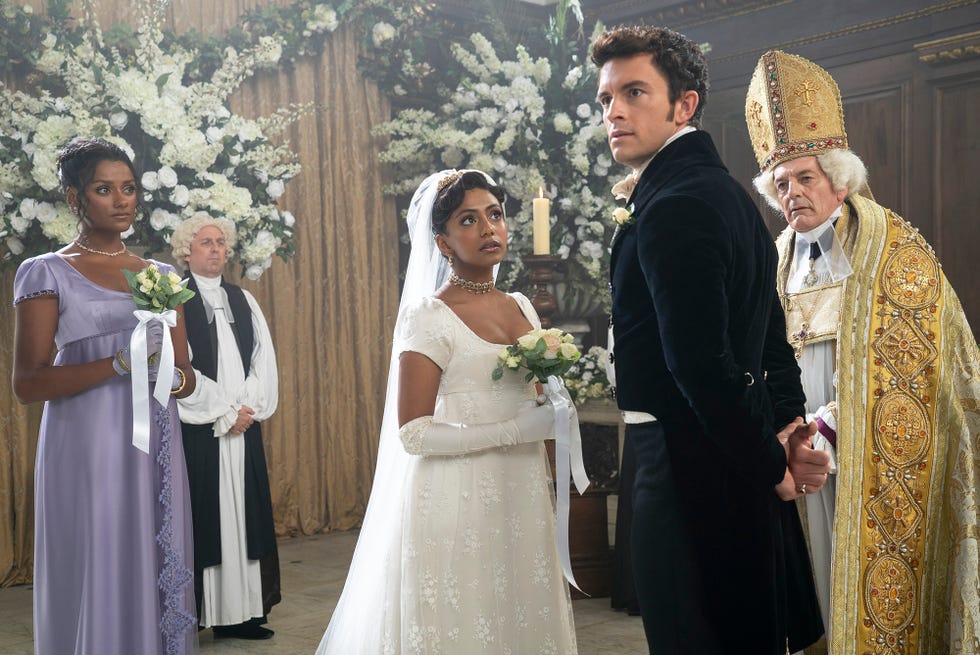
One thing about Bridgerton season 2? It’s really about the tension: whether of a simmering, sexual nature (hello Anthony and Kate!) or the unspoken competition between frenemies (ahem, Eloise and Penelope). When it comes to romance, the series fell back on a time-tested method for cranking up the suspense: ye olde love triangle. Specifically, the show has concocted an agonising will-they-won’t-they love triangle involving Viscount Anthony Bridgerton (Jonathan Bailey) and newcomer Kate Sharma (Simone Ashley), a woman who challenges him with her wit, loyalty and intelligence. Only problem? He's kind of committed himself to marrying her sister Edwina (Charithra Chandran)...so yeah, it's complicated.
Trying to hide their emotional connection – and tbh pretty palpable sexual chemistry – Anthony and Kate tie themselves in knots of guilt, charged glances and subtle touches. And the whole "I love you, but I can't have you" arc makes for some seriously compelling viewing especially in the aftermaths of *that* wedding scene. But while it makes for good tv how common is this dynamic in real life? And what should you do it you find yourself trapped in a love triangle? We're here to give you some answers.
What is a love triangle?
A love triangle is pretty much what it says on the tin: a relationship dynamic involving three people. But in general (especially the way it is depicted in films and tv), it isn't consensual or intentional: unlike a polyamorous triad or throuple structure. Often the love triangle will involve one person who has feelings for two other people, who may feel the need to compete with one another in order to be "chosen" for a monogamous relationship by the object of their affections.
Where have I seen a love triangle before?
Love triangles are a seriously common plot device that you'll no doubt have come across before, not just in Bridgerton but in loaaads of your fave tv shows and films. Think: Daniel, Mark and Bridget in Bridget Jones's Diary; Archie, Veronica and Betty in Riverdale; and Eric, Rahim and Adam in Sex Education.
Do love triangles happen in real life?
IRL, love triangle situations do occur: whether you and your friend happen to fancy and pursue the same person (which some may say is an automatic "girl code" violation) or you're keeping your options open and dating two people but don't know who to pick.
Love triangles are also a common byproduct of infidelity, such as when someone has an affair or develops feelings for someone they have cheated on their partner with. They might also emerge when you're dating someone in an open relationship, but desire to become their only partner.
Everyone's clicking on...
Are love triangles romantic?
Tv makes love triangles look like the epitome of romance and this is partly due to the way they are written, as a sort of "forbidden love". And in real life, some individuals in love triangle situations might feel a sense of excitement and thrill from finding themselves in a ménage-à-trois.
As Dr. Laura Vowels, principal researcher and sex therapist at sex therapy app Blueheart puts it: "Those competing for affection can experience unrequited love in a similar way to forbidden love. The excitement of wanting someone that you can’t have may heighten the desire to win that person over."


But, of course, reality doesn't always match our expectations. It's worth noting that when the initial excitement wears off, there might be considerable stress and conflict: particularly if there has been some level of deception leading to the formulation of the love triangle.
Do love triangles make the chemistry more exciting?
There is a psychological reason why love triangles, such as what we've seen in Bridgerton this season, make such compelling tv: in simple terms, they tap into our love of drama.
As Dr. Vowels explains, for some individuals this might spill over into real life: "Some people can enjoy the competition in a love triangle, and have fun in trying to win over someone else. Even if those feelings aren’t reciprocated, knowing that there are other people in the race can heighten levels of excitement."
And then, there are the people at the centre of the love triangle, who might experience something of a power trip. According to Dr. Vowels, they; "May also get enjoyment in seeing other people battling for their attention. Feeling desired by several others at once can increase levels of self-confidence and even contribute to an ego-boost."
However, while it may be psychologically appealing to be in a love triangle if you're looking for a thrill, it can have longer-term consequences around trust, self-esteem and communication and may be seen as a betrayal. If you want to explore the dynamic but don't want to jeopardise other individuals' feelings, it may be worth exploring options such as polyamory or even consensual sexual/romantic roleplay where you can agree to act out a love triangle scenario with boundaries and safe words. All the drama, none of the hurt.
Why am I always stuck in love triangles?
It might sound like a sure-fire recipe for fireworks but for many people, particularly those who desire a monogamous relationship, being part of a love triangle can be a hugely emotionally draining experience. Life happens and affairs of the heart are complicated, but if you are repeatedly finding yourself in this dynamic (and it's not what you want) it may be worth scrutinising how you can approach things differently.
Dr Vowels explains that individuals may be repeatedly drawn to love triangles, or pursuing individuals who are already spoken for, due to confidence issues. "Often people who have low self-esteem or do not feel like they’re worthy of someone’s love will settle for being on the side rather than having an exclusive relationship with someone," says Dr. Vowels. "If you find yourself often in these situations, you may wish to seek a therapist to help you improve your feelings of self-worth so you can start to feel that you too deserve to have someone who loves you and whose affections you don’t need to question all the time."

And if you're holding out for some validation that you might be "chosen", you might want to think again. "Hoping that the other person will end up ‘choosing’ you can lead to heartbreak. Be honest with yourself and the others in the situation," she says. "The same goes for if you’re the object of two different people’s affections - think about how your behaviour might be affecting them and try not to string people along if you know you’re not interested in them romantically, however much of an ego-boost their attentions are giving you."
How do I end my love triangle?
As with any interpersonal situation, the steps to resolving a love triangle involve honesty, boundaries and communication. "The key to breaking out of a love triangle is to establish boundaries with the other affected people. Communicate your intentions openly, (either with the person you’re trying to pursue, or the person that’s trying to pursue you) and agree on the dynamic of your relationship," says Dr Vowels. "Whether that means maintaining contact at a friendship level, instigating a romantic relationship, or having a complete break in communications for a certain amount of time, make sure that both of you are comfortable with the nature of your interactions with one another."
And, sometimes, it pays to walk away if you're not getting your needs served. "If it’s become clear that your love interest won’t reciprocate any feelings towards you, or if you realise that they can’t give you the attention and respect that you want, it’s also helpful to know when to walk away, to avoid becoming even more hurt in the future."
Megan Wallace (they/them) is Cosmopolitan UK’s Former Sex and Relationships Editor covering sexual pleasure, sex toys, LGBTQIA+ identity, dating and romance. They have covered sexuality and relationships for over five years and are the founder of the PULP zine, which publishes essays on culture and sex. In their spare time, they can be found exploring the London kink scene and planning dates on Feeld.


