I was about eight years old when I first got glasses. My mum had noticed me starting to shuffle ever closer towards the television, squinting at the screen, to watch Pokemon. I was reading Jacqueline Wilson books with my nose buried into the binding so I could see the font. My head would throb at the temples from eyestrain.
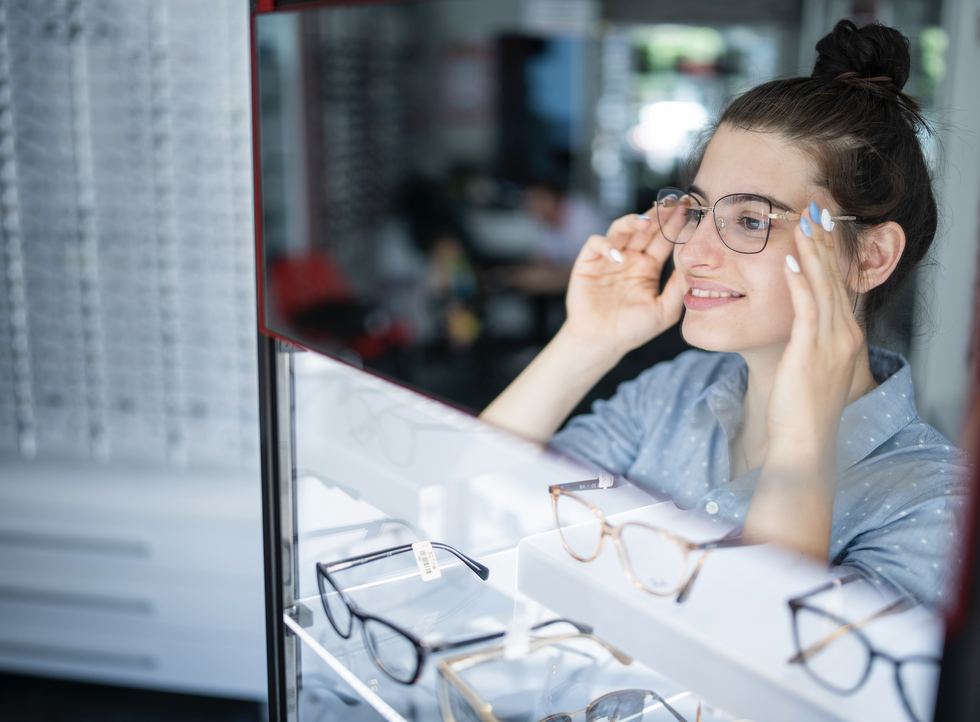
I wasn’t fussed when the optician delivered the news that I'd need to start wearing specs (when I was eight, I was blissfully unbothered about my moonfaced and muppet-ish appearance) but it was the sheer agg of heading to the appointment that I hated. It was a yearly day trip – my mum, my nan, my brother and me would pile into my mum’s battered Citroen Xsara Picasso and drive over an hour to the affluent Gerrard’s Cross (a far cry from my hometown of Slough) to see Fiona, one of my mum’s friends, who would examine our eye health. My mum refused to go anywhere local because she wanted an optician she could 'trust'. "You can’t be too careful with your eyes," she would repeat on the drive to Buckinghamshire (she’s not wrong).
However, my mum’s trust issues and my childhood memories about these boring daytrips have instilled in a me a deep hatred of going to the opticians. And I am not alone in this necessary but hellish life admin task; research by Ocushield finds despite 80% of Brits knowing they should book an eye test once every two years, almost 40% of Brits are overdue – and 24% have never had one, or haven’t been to the opticians in five years (that’s about 14 million people, btw).
For Dhruvin Patel, optometrist and founder of Ocushield, these statistics are a cause of concern, which is why he’s made it his mission to make testing your eyes less of a chore.
Ocushield offers an online screening tool that allows users to conduct a preliminary vision assessment from home in under 10 minutes for £10. This tool is designed to help users identify potential vision changes and encourage them to seek a full eye examination with an optometrist for a comprehensive assessment.
But how does that actually work? And can an online eye screening test really give you an indication of your eye health?

“[Eye tests] are important as our eye health is a huge indicator of our general wellbeing,” Patel tells Cosmopolitan UK. “You might have a melanoma (cancer) in the back of the eye. You might have diabetes, you might have macular degeneration. They just don't know.”
And it’s not just serious conditions that an eye test can highlight – it’s pretty vital part of most of life you’re able to see.
Being able to do a quick vision screening check online is a handy first step for those with busy schedules. While it’s not a replacement for a full eye test, it can help flag when it’s time to book one.
How does an online eye test work?
The Ocushield online eye screening test looks to assess six areas of eye health:
- Visual acuity: A measure of the ability of the eye to distinguish shapes and the details of objects at a given distance (basically how clear your vision is)
- Contrast vision: the ability to distinguish between an object and the background behind it
- Colour vision: whether you see colours in the way we’re mean to
- Astigmatism: whether the lens of your eye has curves (which can lead to blurry vision at all distances)
- Visual field: the portion of space in which objects are visible at the same moment during steady fixation of gaze
- Depth vision: your ability to see objects in three dimensions, including their size and how far away they are from you
It’s important to highlight that this screener does not test your eye prescription – it’s not intended to replace actually going to the opticians to see how long or short sighted you are – but it may be able to give indicators such as whether you have a more serious or underlying problem.
"If someone develops a serious eye condition, it may affect their vision," Patel explains. "Changes in contrast sensitivity, colour vision, or visual field could indicate an issue. While our screening test cannot diagnose conditions like melanoma, it may highlight areas of concern that prompt users to seek further testing with an optometrist."
The set-up is quite simple; you have to set up your laptop so it’s an arms’ reach away from you, and max up the brightness so the tests are most effective.
From there, you have to cover one of your eyes and take part in a series of eye tests that you may recognise from previous visits to opticians. One test sees you click on what part of a circle is shaded out. Another sees you put your finger in front of your face and count if you can see one or two oranges. A third also sees numbers placed in a circle of varying colours.
From my previous trips to the opticians, I know my eyesight isn’t great. I am extremely short-sighted in my right eye (my prescription is a depressing -8), and the lenses in my glasses are so thick that I have to fork out extra to have them thinned down so I don’t look like a comedy nerd every time I wear my specs. But I felt like I was going to be okay at the tests, which I completed all in all in about 15 to 20 minutes.
The results were downloadable straightaway, and I immediately I saw that I’d bombed out in two of the six tests: my visual field and my depth perception were branded as ‘poor’ in both eyes.
“If your eyes have failed this screening test, this may be a sign of central vision changes in your eye(s), we recommend further investigation to identify if anything needs to be done to correct this,” the results read. I feel my heart sink and the thought of needing an ever higher prescription.

My poor depth perception was another worrying issues: “This may be a sign of the muscles in the eyes not working as they should.”
With the results sternly telling me I had to go back to the opticians, I reluctantly picked up the phone and made an appointment to see them for another eye test.
It’s something that Ocushield has some success in fielding. Around one in 10 people who pass all the six screening tests end up booking a follow-up appointment. But this shoots up to one in five people (24%) who book a further appointment if they fail any part of the screener.
What did my follow-up eye test find out?
In person, an optician scanned my eyes and tested my prescription. He found my lazy right eye was showing signs of general wear and tear not unusual for someone my age. He told me my prescription had worsened slightly (great). While my field test showed my visual field was healthy, he added my poor depth perception was mostly likely due to the vast prescription differences between my two eyes. I skipped off out of the opticians reassured.
While it is worrying to know there may be further problems with my already dodgy eyesight down the line, it is helpful to know that this is something that has been picked up early doors - and can be treated quickly.
“When I ask people which of the five senses they’d never want to lose, they always say sight,” Patel explains. “But so many people really fail to look after their eyes. We really take our vision for granted. It’s something I’m passionate about changing.”
So next time you hear your mate talking about their ‘20/20 vision’, maybe they suggest they put their money where their mouth is and try the Ocushield screener?
Kimberley Bond is a Multiplatform Writer for Harper’s Bazaar, focusing on the arts, culture, careers and lifestyle. She previously worked as a Features Writer for Cosmopolitan UK, and has bylines at The Telegraph, The Independent and British Vogue among countless others.