For most women, periods are a normal monthly occurrence as regular (and annoying) as rent. That is unless you're pregnant, on some type of contraception, or have a health condition like PCOS that makes your TOTM irritatingly irregular.
And if the whole bleeding out of the vagina part isn't enough, our periods are typically joined by an array of PMS symptoms, from stomach cramps, mood swings, tender breasts, fatigue, irritability, and even certain food cravings. Oh, and let's not even mention the fact that we have to shell out for period products every month, too.
But, while the above TOTM accompaniments are pretty common for most women, what about the lesser known symptoms? Including one of the rarest of all: the decidual cast.
This is a female health condition that happens when your body isn't quite working as it's supposed to. Although it's not thought to be health threatening, it does mean that a woman's uterus, instead of shedding its lining across a series of days (a regular period), evacuates all in one go and emerges in the shape of the womb.
Granted, if this is the first time you're learning of the phrase, it likely means you've never experienced this symptom. But, it doesn't mean you shouldn't be aware of it. This is why we've spoken to the experts who explained what exactly a decidual cast is, why it happens, and when to worry. As always, if you experience any health scares that are playing on your mind, do book a GP appointment. It's always better to err on the side of caution.
In the meantime, keep reading for a doctor's breakdown of a decidual cast, and what it means for you if you experience one.
Everyone's clicking on...


What is a decidual cast?
First, let's revisit some basic physiology. Each month, the lining of your womb (scientific name 'endometrium') thickens up. This thickened endometrial tissue is called a 'decidual lining'.
Normally, if you're not pregnant, you'll experience a monthly bleed. Across the course of five to seven days, you shed a combination of that endometrium and period blood in dribs and drabs. Dr Deborah Lee, of Dr Fox Online Pharmacy, explains that this is why your "period blood can look lumpy and irregular."
But, as noted, a decidual cast happens when the entire womb lining is shed. "When it does occur, instead of shedding the decidual lining little by little as you normally do, the entire decidual lining is expelled all in one go," Dr Lee states. Unfortunately, this can cause severe period pain.
Why do women experience a decidual cast?
The good news is that "having a decidual cast is very rare," says Dr Lee. Seriously, in over three decades of working in General Practice and Community Sexual and Reproductive Health clinics, she has only ever seen "one patient with a decidual cast."
But even though it's so rare, it doesn't mean that it can't happen. Dr Lee notes that a decidual cast is most common in women between the ages of 20 to 40 who have experienced an ectopic pregnancy. This is when a fertilised egg implants itself outside of the womb.
Additionally, a paper in Internet Scientific Publications shared a report on the medical occurrence, concluding that it's most common in pregnant women (as above, more specifically with ectopic pregnancies, which it could be a sign of). Though the signs can mimic a miscarriage, a decidual cast is different, and you should always consult your doctor.
As per the paper, there have been reported instances of non-pregnant women experiencing a decidual cast, too. These have been put down to the side effects of human menopausal gonadotrophin (HMG), a medication used to treat fertility issues, and progestogens, which are used widely for hormonal contraception. The latter of which begs the question: is it time to stop using your contraception?
While that's strictly your decision, if a decidual cast is the reason you're contemplating ditching the pill or other forms of contraception, Dr Lee offers some reassurance.
"There is absolutely no need to stop using your contraception because of fear over having a decidual cast. It's very important to continue taking your contraception correctly and carefully," she says.


Decidual casts have been reported in:
- Women taking combined oral contraceptive pills containing the progesterones drospirenone, cyproterone acetate, norgestimate, and desogestrel.
- Women using the contraceptive patch (Evra), which contains the progesterone norelgestromin.
- Women using the injectable contraceptive, Depo Provera, which contains the progesterone medroxyprogesterone acetate (MPA).
- Women using the contraceptive implant Nexplanon, which contains the progesterone etonogestrel.
- Women undergoing fertility treatments, using injections of Human Chorionic Gonadotrophin (HCG).
However, Dr Lee also stresses that no exact causation of decidual cast has ever been firmly (or scientifically) established. She advises: "If you are concerned, keep using your contraception carefully, as directed, and make an appointment to discuss this with your GP, or at the sexual health clinic."
What do I do if I think I've experienced a decidual cast?
First up – don't panic. Although rare, you are not alone. As previously mentioned, Dr Lee explains that having a decidual cast is "likely to be very unpleasant."
"It's extremely painful, partly because of the physical passage of such a large piece of tissue through your cervix (neck of the womb)," she says. Other symptoms may also include dizziness, nausea and sickness, and feeling faint.
Plus, because the "vast majority of women have never heard of a decidual cast," finding the fleshy mass in your underwear or in the toilet can be really disturbing. Dr Lee states that this is also because most women assume they've experienced a miscarriage, "although they had no idea they could be pregnant."
If you have any suspicion you could have passed a decidual cast, Dr Lee strongly advises you to see a doctor without delay. Either call 111, head to A&E or get a same-day appointment with your GP or a local sexual health clinic.
While you wait, she also shares that you should:
- Do an at-home pregnancy test
- Take simple analgesia, such as ibuprofen and/or paracetamol
- Do not stop using your regular method of contraception
- Stay calm
Dr Lee reassures: "Once the tissue has been passed, the symptoms usually settle very quickly." Though it might sound grim, she recommends taking the lump of tissue you passed to the appointment to show the doctor. "This can be sent to the pathology laboratory for analysis to confirm the diagnosis," she explains.


Does a decidual cast have links to endometriosis?
While there is no solid link between endometriosis, a condition which sees tissue similar to that found inside the womb growing elsewhere in the body causing scarring, pain and other symptoms, some people with endometriosis will have experienced a decidual cast. While more research is needed, it's thought that sadly those with endometriosis have an increased risk of an ectopic pregnancy (a pregnancy forming outside of the womb), which could in turn lead to an increased risk of a decidual cast.
It's also thought that the formation of a decidual cast could be linked to hormone therapies or taking the contraceptive pill, which some endo sufferers may do while searching for a treatment or pain management plan.
Some with endometriosis may also experience heavy periods, featuring clots of varying sizes, possibly due to hormonal imbalances.
What is it like to experience a decidual cast?
Curious to know a little more about what a decidual cast feels like? These two accounts by Reddit users shed a little light on their experiences:
"I was terrified it was a weird mass of foetal tissue"
So I'm having my period, and it's WAY crampier than usual. I curled up around a hot water bottle... last night and then slept with this water bottle too. It wasn't the usual achey cramps but the super stabby cramps that radiate down the lower back.
Fast forward to today. I'm changing my tampon and the nastiest blood clot I've ever seen in my life is dangling out of me. I give it a tug with some toilet paper and this huge mass of white tissue comes out with it. I drop some f-bombs and I'm terrified it's a weird mass of foetal tissue and I just had a miscarriage after not knowing I was pregnant and this queues up a whole lot of anxiety.
Doctor Google, however, tells me it's a decidual cast, or "My Uterus Just Tried To Shed Its Entire Lining In One Go". Google this for some descriptive and nasty photos (or just imagine a uterus shedding its skin like a snake and you're left with a replica of your uterus that escapes out through your vagina).
[via Indiana_meg]
"I was a little weirded out"
I recently got the implant (1 month) and I've just started spotting. I was standing up and got that clumpy oozy feeling you get when you're about to pass a huge chunk of tissue. So afterwards I go to inspect the damage and if I have to change liners.
I have something like this. I didn't take a picture of my own cause I was a little weirded out but I was Google searching. Apparently, it's some sort of shedding of uterine lining and happens with progesterone.
[via Ipromiseitsnotglue]
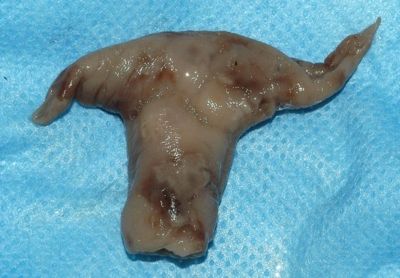
What does a decidual cast look like?
The aforementioned paper came with an accompanying image. However, before you take a look, know that it's extremely graphic. So, if you are prone to feeling queasy, we would advise you stop scrolling here.
Warning: graphic images below

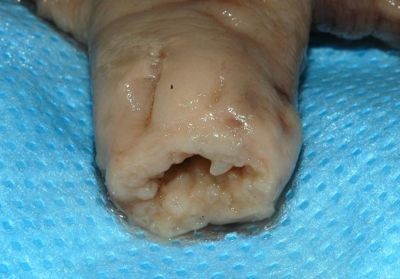
This is what it looks like from underneath:

This article is not intended to be a substitute for professional medical advice or diagnosis. Always seek the advice of your physician or other qualified health provider with any questions you may have regarding a medical condition.

Sophie Williams is a Freelance Journalist and Copywriter, covering everything from Fashion to Entertainment to music, Lifestyle and Features. She has interviewed a range of musical artists and authors including Alyssa Edwards, Courtney Barnett, Confidence Man, The Vaccines, Loyle Carner, Gabrielle, and John Niven, and has written for publications like Metro, Reader's Digest, ITV's Woo! and Vice’s NBGA. She is also working on a book for HarperCollins about Taylor Swift, due to be published in 2024.