
Have you ever heard someone (quite possibly your mum, after spotting you yawning for the tenth time at dinner) say that sleep before midnight is worth more – or is more 'valuable' – than the sleep that comes after? So, essentially, getting an early night is key to feeling refreshed and restored? Us too, but as with anything, we're always keen to hear it from a bona fide expert before fully buying into it (sorry, mum).
With that in mind, intent on finding out if sleep before midnight actually is somehow more magical in comparison to all the hours of snoozing that come post 12am, we had a chat with Dave Gibson, an expert at eve Sleep (you know, the ones who make the famous hybrid mattresses) and founder of The Sleep Site.
Sleep research has come a long way, he begins, saying, "It’s now known that if we sleep in line with our individual body clock (or 'circadian rhythm'), that we get the best sleep possible – both in terms of quality and quantity. For most adults this means an optimum window of falling asleep between 10pm and 12pm midnight."
Gibson then notes that recent research supervised by Exeter University showed that those who fell asleep between 10pm and 10:59pm also had a lower risk of cardiovascular disease than those who dozed off earlier or later.
"Those who went to bed after midnight had a 25% increased risk of cardiovascular disease," he explains. "The reason being is that when we sleep out of line with our body clock we experience increased inflammation, problems with glucose regulation and insulin resistance, all of which contribute to and are risks for cardiovascular disease."
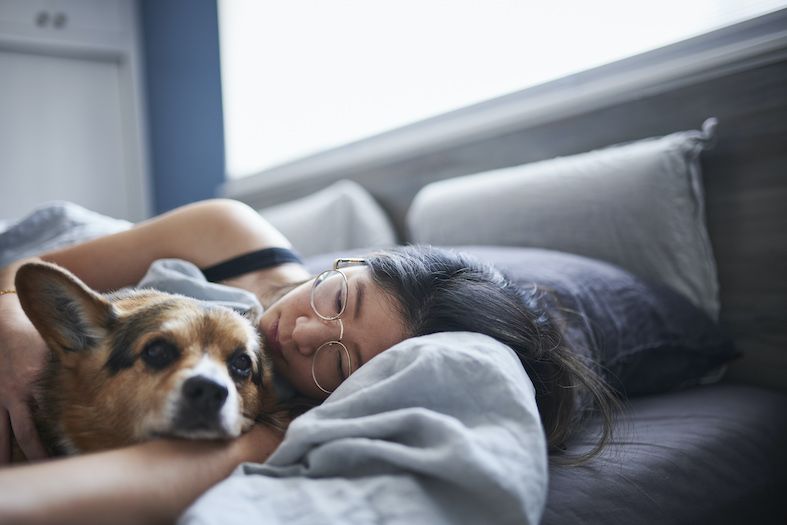

"Our body and brain tend to repair better too before midnight, so much so that those some studies (one of which examined 400,000 people over the space of 6.5 years) have even suggested those who get to bed before midnight tend to live longer than those who don’t."
However, if you're now pranging out about the fact you regularly go to bed at 1am (same), fear not – we're not all designed to fall asleep before midnight. "One of the researchers' conclusions was that the lifespan impact may be due to psychological and physiological risk factors related to poor health, such as smoking and alcohol intake, irregular eating habits and lower physical activity, previously been associated with evening-types." And thankfully, those lifestyle choices are something we very much do have control over.
"Research has shown that somewhere between 20% to 30% of adults [naturally] have a Night Owl Chronotype and they typically get an extra burst of energy at night," Gibson continues. "This may be a hangover from prehistoric times, wherein some of the tribe would need to stay awake and watch for danger as the others slept."
It's also thought that teenagers are more likely to naturally favour a post-midnight bedtime too, as the teenage body clock undergoes a circadian shift to create a 'Super Night Owl' sleep pattern and melatonin, the hormone which generates our desire to sleep, is secreted approximately two hours later than adults or children.
"This is why teenagers struggle to get to sleep before midnight, it’s thought that this [also a hangover from pre-historic times] is to enable a 'mini tribe' to be created, aiding in social development with teenage peers away from the adults," adds Gibson.
Keen to find out whether you're in the 20% of the population who just can't get enough of a late night? "One way of trying to work out your Chronotype naturally, would be to go to bed when you feel tired and allow yourself to wake up refreshed without an alarm," he advises. "Over a short amount of time this will give your body clock the chance to reset back to its genetic chronotype both in times of sleep timing and sleep length.
"In addition, there are several tests you can take to determine your sleep preferences or chronotype. One popular one is called the 'Morningness-Eveningness' questionnaire (MEQ) which is available online and takes between 5 to 10 minutes to complete."
The bottom line of it all (and some final reassurance for any fellow 1am bedtime clubbers)? "As long as you're getting over 6 hours (ideally 7 to 9), you're getting the right amount of sleep," says Gibson. "It's just that we now know that the optimum window, for most people, falls between 10 pm and 11pm."
Jennifer Savin is Cosmopolitan UK's multiple award-winning Features Editor, who was crowned Digital Journalist of the Year for her work tackling the issues most important to young women. She regularly covers breaking news, cultural trends, health, the royals and more, using her esteemed connections to access the best experts along the way. She's grilled everyone from high-profile politicians to A-list celebrities, and has sensitively interviewed hundreds of people about their real life stories. In addition to this, Jennifer is widely known for her own undercover investigations and campaign work, which includes successfully petitioning the government for change around topics like abortion rights and image-based sexual abuse. Jennifer is also a published author, documentary consultant (helping to create BBC’s Deepfake Porn: Could You Be Next?) and a patron for Y.E.S. (a youth services charity). Alongside Cosmopolitan, Jennifer has written for The Times, Women’s Health, ELLE and numerous other publications, appeared on podcasts, and spoken on (and hosted) panels for the Women of the World Festival, the University of Manchester and more. In her spare time, Jennifer is a big fan of lipstick, leopard print and over-ordering at dinner. Follow Jennifer on Instagram, X or LinkedIn.


