Pregnancy (obviously) brings about huge physical and mental changes, regardless of which month or trimester you're in – but there are yoga poses out there which can help with prenatal discomfort as well as keeping calm. To find out more about pregnancy yoga, we spoke to yogi expert Nadia Narain, a teacher at triyoga, who recommends these five moves to help with aches, nerves and feeling at home in your newly transforming body.
"Lower back pain and shortness of breath are just two common examples of physical symptoms during pregnancy that yoga can help with," says Nadia. "Some yoga poses can even help with labour too."
So, if you can't make it to a prenatal class in person, here are a few poses to try at home (and a list of which moves to avoid) while pregnant.
Pregnancy yoga: Cat Cow
"The Cat Cow position relieves back pain and helps to keep the spine flexible throughout pregnancy," notes Nadia. It can be done for 30 seconds to a minute and at any stage of pregnancy.
"Come onto your hands and knees, then move the pelvis forward and backwards, the aim here is to try and find an arch and a rounding of the back – if you experience any issues with your wrists, try gently lowering your forearms to the ground instead," she advises. Keep your wrists under your shoulders and knees under your hips – if your knees feel a bit tender, try folding a blanket underneath them.
Like with all yoga moves, if you experience any pain, don’t push that pose.
Everyone's clicking on...


Pregnancy yoga: Pelvic Rotation
Whereas a Cat Cow uses a forward and back movement of pelvis, this move requires you to rotate it. "Slowly rotate your pelvis round, eight times clockwise, then eight times anti-clockwise," says Nadia. "This is an excellent movement to do throughout pregnancy and during the early stages of labour, as it helps with general pain management." This pose can be done at any stage of pregnancy and for up to a minute in each direction. Again, if you have issues with your wrists, bring your forearms to the mat (or ground).
Pregnancy yoga: Squat
The squat is another move that can help in labour and is ideal at any stage of pregnancy (apart from if you have a low lying placenta, in which case it's not advisable to try this one). "When you get into a squatting position, it opens up and widens the pelvis. It also helps to keep a sense of calm and connection to the body," explains Nadia.
Place your feet a little wider than your hips and come to a sitting position on some cushions (or a bolster). "The cushions are there to provide support under your pelvis but if you need a little more, you could also try leaning your back against a wall too," she says. "Stack them as low or as high as you feel is comfortable, then hold the pose for five to eight breaths." Inhale and give a long sigh as you breathe out – do this two times with your natural breath (don't worry about trying to do it for a certain number of counts or length of time). Then, inhale and make a deep, low sound as you exhale (do this twice). Finally, repeat your inhale and blubber your lips as you exhale (again, do this twice).


Pregnancy yoga: Breathing
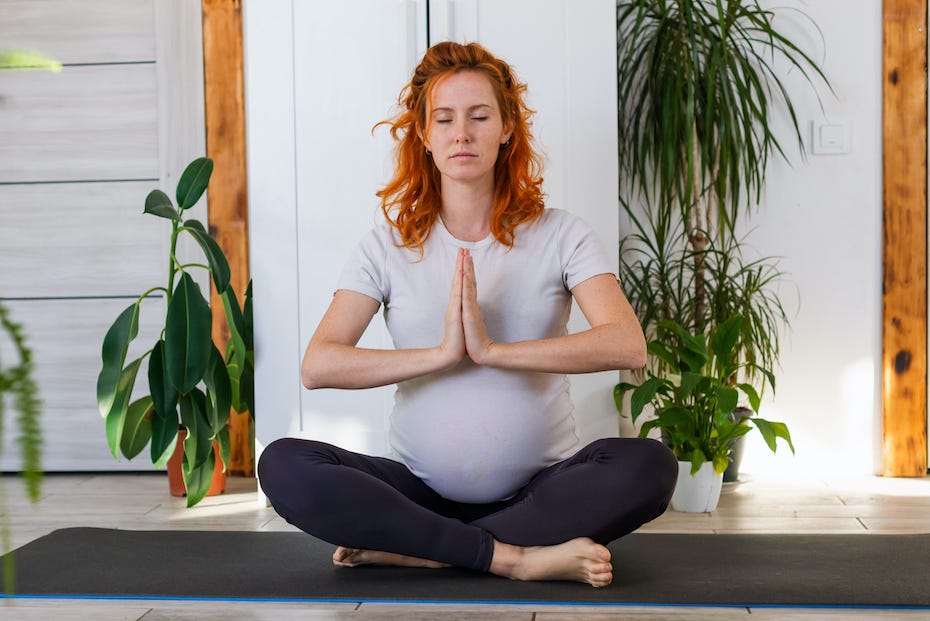
It may sound obvious, but breathing really is one of the key things that expectant mothers can practice during pregnancy, which will be helpful during labour (and in mothering), as it helps to calm and relax both the mind and body. "Sit up straight, put your right hand on your belly (baby) and put your left hand on the heart centre (the middle of the chest), then breathe from the belly to the chest," guides Nadia. "On your exhale, feel the belly soften back towards you." If it’s tricky to sit with your legs crossed and a tall spine, try sitting on the edge of a chair instead, focus on keeping your spine straight and feet flat on the ground. This can be done at any stage of pregnancy.
Try the following breathing sequence:
Inhale for four counts, exhale for four (repeat twice)
Inhale for four counts, exhale for six (repeat twice)
Inhale for four counts, exhale for eight (repeat twice)

Pregnancy yoga: Standing Pose
Start with your arms alongside your body and as you inhale, reach your them out and up and over your head. Then, as you exhale lower them back down towards the sides of your body. "Inhale for four counts on the way up, exhale for four counts on the way down," says Nadia. "Do this 6 to 8 times." She also advises that this move is helpful if you've been sitting at a desk all day. "It's good for posture, creating space through the sides of your body and helps to get the body and breathe in a nice, steady rhythm."
Yoga moves to avoid in pregnancy
"There are a few poses that should be avoided during pregnancy, namely ones which engage the abdominals," says Nadia. "As the belly is growing, it needs to soften. Other parts of a woman's body can be strengthened while pregnant though, such as her arms, legs and mental resilience."
Plank Pose
We are trying to soften the belly during the pregnancy, not make it harder.
Deep Twists
Deep twisting is not suggested at any stage of pregnancy, but as you grow, it will be something that won’t feel right.
Inversions (such as Downward Facing Dog, Headstand or Bridge Pose)
"Pregnancy isn't really the time to be going upside down," says Nadia. "Besides the fact that most inversions require a lot of abdominal work, during a pregnancy, one aim is to try and get the baby into an optimal position."
Bow Pose or Cobra
These moves both involve laying on your belly and applying pressure, which won't feel comfortable or right after the first trimester.
Crow
Or any other kind of balancing pose where you're using your abdominals to hold a position.
This article is not intended to be a substitute for professional medical advice or diagnosis. Always seek the advice of your physician or other qualified health provider with any questions you may have regarding a medical condition.
Jennifer Savin is Cosmopolitan UK's multiple award-winning Features Editor, who was crowned Digital Journalist of the Year for her work tackling the issues most important to young women. She regularly covers breaking news, cultural trends, health, the royals and more, using her esteemed connections to access the best experts along the way. She's grilled everyone from high-profile politicians to A-list celebrities, and has sensitively interviewed hundreds of people about their real life stories. In addition to this, Jennifer is widely known for her own undercover investigations and campaign work, which includes successfully petitioning the government for change around topics like abortion rights and image-based sexual abuse. Jennifer is also a published author, documentary consultant (helping to create BBC’s Deepfake Porn: Could You Be Next?) and a patron for Y.E.S. (a youth services charity). Alongside Cosmopolitan, Jennifer has written for The Times, Women’s Health, ELLE and numerous other publications, appeared on podcasts, and spoken on (and hosted) panels for the Women of the World Festival, the University of Manchester and more. In her spare time, Jennifer is a big fan of lipstick, leopard print and over-ordering at dinner. Follow Jennifer on Instagram, X or LinkedIn.