Lyme disease is a condition that many people will have heard of (thanks to a rise in celebrities talking about their experience of it on social media), but plenty of us still aren't sure what exactly it is – beyond the fact it's something to do with ticks.
Recently, Bella Hadid – who suffers from the disease – took to Instagram to update fans on her health, after many shared concerns that she'd missed key dates in the fashion calendar and appeared to have gone AWOL.
In her post, the model explained that she's been struggling with Lyme disease along with co-infections, and shared a series of images of her hooked up to IVs. Plus, doctors' letters dating back to 2014 detailing the medical problems she was suffering from, which included fatigue, memory disturbances and chest pain.
Thankfully though, it looks as though Bella is now on the mend after enduring "100+ days of Lyme, chronic disease, co-infection treatment" and "almost 15 years of invisible suffering."

Bella isn't the only celeb being open about her diagnosis either. Riley Keough also got candid about her experience with the disease when speaking to Vanity Fair, meeting the journalist interviewing her at a "holistic treatment centre" to try and boost her immune system. She also explained that her diagnosis was the reason she opted for surrogacy back in 2021.
"I can carry children, but it felt like the best choice for what I had going on physically with the autoimmune stuff," she said.
And while other famous faces like Justin Bieber, Avril Lavigne and Ashley Olsen are openly battling, or have experienced, the (more common than you'd think) illness, it's worth taking a deep dive into Lyme disease so you can be aware of the causes, symptoms and treatments.
What is Lyme disease?
"Lyme disease is an infection caused by bacteria called Borrelia burgdorferi, which are spread by ticks," says Dr Deborah Lee, from Dr Fox Pharmacy. "Ticks are insects which live in moorlands and woods. They feed on the blood of small animals and birds which carry these bacteria. The tick then bites a human and transfers the bacteria in its saliva into the person's bloodstream."
According to Dr Lee, tick-borne diseases are a group of infections spread by infected ticks and refer to illnesses including Lyme disease. Plus others like Babesiosis, Crimean Congo Haemorrhagic Fever, Rickettsiosis and Tick-borne encephalitis.
"The ticks are found in woodlands all across Europe and the UK," outlines Dr Lee. She reveals the New Forest, Exmoor, The South Downs, Thetford Forest, the Lake District and the Scottish Highlands and islands are the most common UK areas they can be located.
"A tick may only have a small bite, but it can cause a major infection," she warns.
What are the symptoms of Lyme disease?
Dr Lee says the most common symptom of Lyme disease is the typical bull's eye rash. "This has a red central area where the bite occurred, then a circular area of normal skin, with a red ring around the outside – looking like a target on a dart board."
She notes that the rash can be quite large, measuring 12-35 cm in diameter and is usually flat or slightly raised, but not hot or itchy.
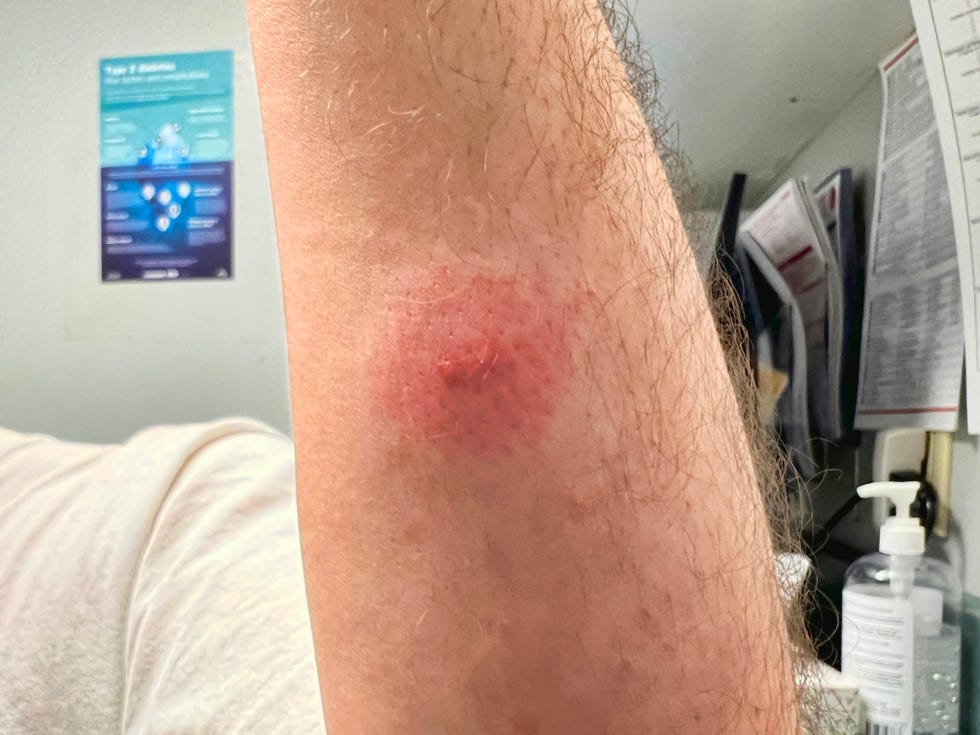

"Not everyone who gets bitten will develop the rash – it is absent in 30% of cases," she explains.
Dr Lee also cites a high temperature, flu-like symptoms (chills), neck pain and stiffness, headache, joint pain and tiredness and fatigue as key symptoms. However, she does note that 7% of those with Lyme disease have no symptoms and it can remain untreated for months and years.
On top of this, she adds that "chronic Lyme disease can cause arthritis, memory problems, neurological symptoms, Bell's palsy, cardiac arrhythmias, depression and anxiety" and can also be "a cause of chronic fatigue with a clinical picture similar to chronic fatigue syndrome."
Although rarely fatal, Dr Lee does warn that 1-10 in every 100 cases of Lyme disease will develop Lyme carditis. "This causes heart block – a serious defect in the electrical activity of the heart," so it's important to book in to see your doctor if you do think you're experiencing any symptoms of Lyme disease.
How is Lyme disease treated?
For early disease, "a short course of an antibiotic is used to treat Lyme disease, such as amoxicillin or doxycycline" notes Dr Lee.
Sometimes, though, a longer course is needed of up to 28 days. While in severe cases, she reveals intravenous antibiotics may be given.
Can some people be more susceptible to Lyme disease than others?
Dr Lee warns that anyone can get Lyme disease, "but it is most common in those aged 16 to 30 years."
She says that people who spend a lot of time outdoors are more likely to experience it, but that, while most cases occur in May or June, a person can actually be affected at any time throughout the year.
"Unfortunately, a small number of patients continue to have symptoms after treatment. This is called Post Treatment Lyme Disease Syndrome (PTLDS)," she adds.
How to prevent Lyme disease
"Lyme disease can be prevented by taking sensible measures when outside," Dr Lee outlines. This includes wearing long trousers and long-sleeved tops, with a hat that covers the back of the neck. Plus, socks tucked into trousers.
"Stick to the middle of the path and avoid brushing against long grasses and bushes and use insect repellent containing DEET," she advises.
"Check yourself for ticks after a walk and remove them at once," she urges. "Use fine tweezers to grab the neck as close to the skin surface as you can, and pull upwards with a steady pressure."
And if you have pets "make sure you check them as they can become infected too." Although currently, there is "no evidence that Lyme disease spreads from pets to owners."
Both Dr Lee - and the NHS - warn that it's always advisable to see your GP for advice about insect bites and possible Lyme disease.
..
Sophie Williams is a Freelance Journalist and Copywriter, covering everything from Fashion to Entertainment to music, Lifestyle and Features. She has interviewed a range of musical artists and authors including Alyssa Edwards, Courtney Barnett, Confidence Man, The Vaccines, Loyle Carner, Gabrielle, and John Niven, and has written for publications like Metro, Reader's Digest, ITV's Woo! and Vice’s NBGA. She is also working on a book for HarperCollins about Taylor Swift, due to be published in 2024.