If you've got a full rotation of lip stains, lip glosses, and tinted lip balms in your bag at all times and are rarely seen leaving the house without something defining your lips, we can see why you've clicked onto this article about lip blushing. The semi-permanent makeup treatment adds a wash of colour to your lips and helps define your lip shape for years. Think: natural-looking lipstick 24/7, but without the mess — a dream, right?
That being said, any cosmetic treatment that’s even slightly permanent requires a massive amount of research. So, to find out whether or not lip blushing is safe, how painful it is, and what to expect during an appointment, we tapped four experts for help and got the first-person account from two Cosmo writers who actually got lip blushing, one successful, one a learning curve. Keep reading, and get ready to take notes.
What is lip blushing?
Lip blushing is semi-permanent, tattooed makeup that tints your lips using a cosmetic tattoo gun (on a low setting) and water-based inks. The result is kind of similar to lip fillers —in that your lips will look a little fuller simply by being defined and enhanced with pigment—but lip blushing won’t actually change the shape or feeling of your lips. Instead, it’ll just leave you with a soft, shaded-in colour that can enhance your lip symmetry, cover uneven pigmentation or scars, and give you the illusion of bigger, fuller lips.
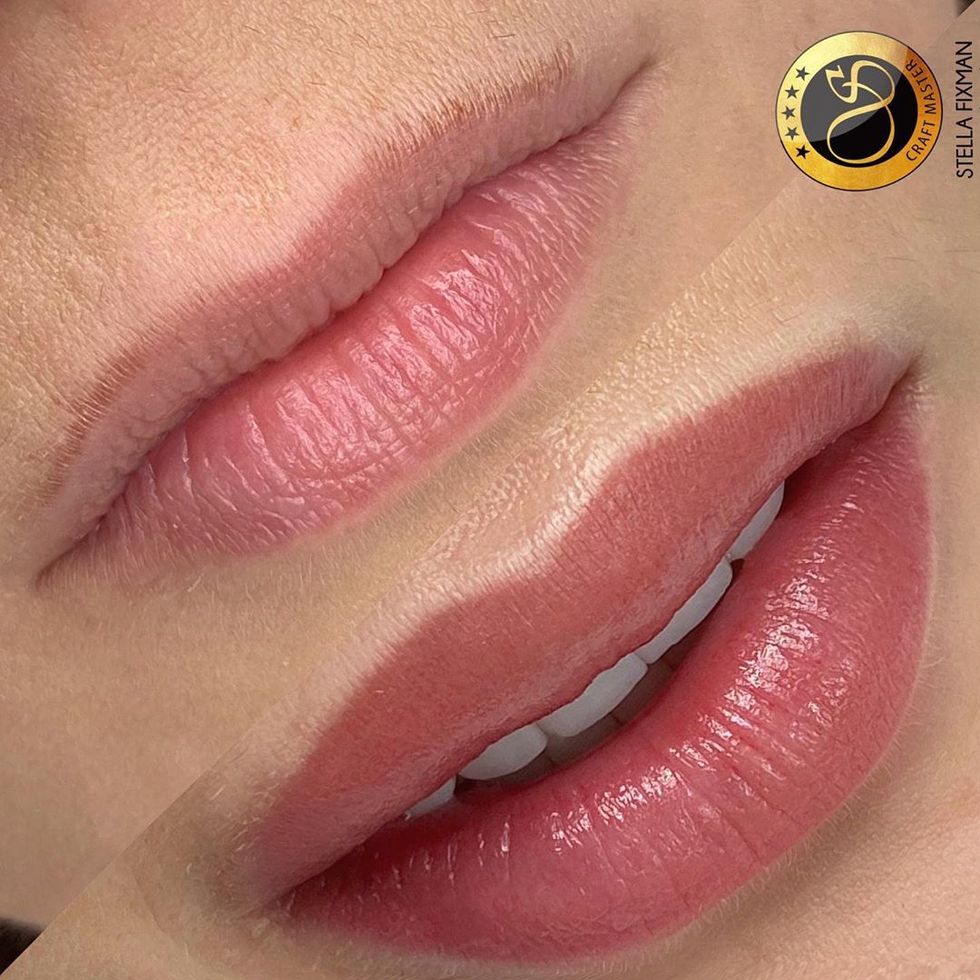
The exact colour should ideally be a collab between you and the tattoo artist. "I take into account their skin tone, natural lip colour undertone, and lifestyle factors," says Nika Randall, a senior lip blushing artist at Hairy Little Things in Los Angeles, CA. "During our consultation, some clients may also bring me inspo colors via my Instagram." You can also bring in your go-to lip colours to give your artist an idea of what you like.
Does lip blushing damage your lips?
No — lip blushing, when done safely and correctly, will not “damage” your natural lips. The emphasis here is on “correctly,” which is why it’s so important to know what to look for before your appointment (more on that later). But, in general, “it’s unlikely you will have any long-term damage to your lips from lip blushing,” says physician assistant Amy Koberling.
Lip blushing generally doesn’t leave behind any scars, but it can leave your lips swollen, irritated, and scabbed-over for the first week. That being said, there are always risks to be aware of with any cosmetic procedure, especially if you’re prone to irritation around your lips, so make sure to discuss any concerns, allergies, and skin sensitivities with your artist before you make the appointment.
Is lip blushing safe?
“Lip blushing is a largely safe treatment when performed by a qualified and experienced professional,” says Koberling. Still, to set yourself up for the best and safest results, it’s vital that you discuss your skin history with your artist beforehand, like whether you deal with eczema, acne, cold sores, or rashes around your mouth, so they can determine if you’re a good candidate, or if they need to take special precautions (like going slower or using lighter strokes) to avoid irritation.
But, again, a semi-permanent tattoo is only as safe as your artist makes it. “With all procedures, there can be complications, so be sure the professional you choose is well-equipped to handle any that may arise,” adds Koberling (more on how to suss that out below).
Is lip blushing better than lip injections?
Lip blushing isn’t “better” or “worse” than lip injections — it’s all just personal preference. Lip blushing will add colour and definition to your lips, while lip fillers will add volume and shape. They both last about a year before requiring touch-ups, take a week or so to heal, and have about the same level of pain. So again, it really just depends on the results you want, but know that you also don’t have to choose: You can get both lip blushing and lip injections, as long as you wait six weeks in between, and start with the filler first.
Does lip blushing make lips look bigger?
Yep, lip blushing can make your lips look a little bigger but it can’t add any real volume. It can make your natural lips look more defined, especially around the Cupid’s bow, which will give you the illusion of more depth and fullness. You can also chat with your artist to see if they're able to add a colour gradient to the edges of your lips to increase the volumising effect even more. But, again, if you're looking for true volume, go for lip filler (or both).
How to prep for a lip-blushing appointment
First, Randall tells her clients to hydrate—both internally and externally—a few days before their appointment, as well as exfoliate their lips with a scrub. Them, 24 hours before the procedure, "avoid alcohol and blood thinners — and skip caffeine the morning of your appointment, as these all may cause bleeding and not allow the pigment to set," she says.
Heads up: If you're prone to cold sores, you *have* to get a cold sore medication prescribed by your doctor. "Take it a few days before, the day of, and a few days after the procedure," says Randall.
How long does lip blushing last?
Typically, lip blushing lasts between two to three years and will gradually lighten and fade over time, until your lips slowly return to their natural shade. So you can expect your lips to look far lighter after two years than they will after six months, which is why many tattoo artists recommend yearly touch-ups to prolong the lip colour you want.
How bad does lip blushing hurt?
Even though, yes, it’s a tattoo on your mouth, your tattoo artist should use a topical numbing cream that’ll significantly dull your pain. You might only feel a mild scratching or pinching sensation, according to Randall, who notes that her clients have rated it — at most — a 4 out of 10 on the pain scale.
Lip blushing review 2025
Cosmo UK Commissioning Director Catriona Innes gives the lowdown on her successful lip blush treatment...
What to expect from a lip blush appointment and how to prep
I was supposed to start my preparation for the appointment the week before, by applying Zovirax, a cold sore cream, as a preventative measure. I haven’t had cold sores in years but the lip blush process is said to aggravate them and cause an outbreak, so to prevent this you’re to speak to your pharmacist for a preventative measure, either in a cream or tablets. Time, as it seems to do these days, ran away with me and, erm sorry, I only started doing this two days before. I didn’t mention this to Karen (Betts, one of the UK's top permanent makeup pros). Anyway, I did arrive half-an-hour earlier, as instructed, as you need this amount of time for the numbing cream to set in.


The numbing cream is basically a thick white cream that, slowly but surely, gets to work making the entire bottom of your face feel pleasantly numb. It’s like you’re very aware of the fact your lower face is there, it exists but, you can’t feel it. This, it also turns out, is just the initial numbing cream, there was more to come. But first, I had a consultation with Karen, she she asked me to look at my lips and ask me what I thought of them (I wasn’t sure what to answer to this, I kinda shrugged and said ‘fine, but in need of something’) and then what I wanted from the treatment (I cited Benetint and said I’d like that colour but permanent) then she lined my lips to give an impression of what they might look like. Already I was impressed, they looked so much fuller and more pronounced.
I then lay down, and Karen applied more numbing cream and got to work. The initial cream just numbed the top layer, so she explained it might sting a little at first, until the second layer of numbing cream set in. Karen checked in to see how painful I found it, out of ten, and I said three, and I wasn’t being polite. Anyone who has had an actual tattoo will be familiar with the feeling, it’s like being scratched with a small needle, part ticklish, part painful. But this must have only lasted about five to ten minutes, and then it felt like, well, a vibrator going across my lips. I was aware of it but, apart from having to breathe through my nose and, worrying about my overwhelming need to sneeze (I didn’t, and was told this is a normal way to feel) the whole process, which took about an hour, was much better than what I had been expecting. The recovery, however, was a different story…
The lip blushing recovery process
It was impossible to tell what colour my lips were going to be when I left the salon. Equipped with a soothing balm, which I was to apply using a cotton bud, along with my Zovirax to carry on (ahem) my cold sore prevention, I left and began frantically snapping pictures to send to my friends. My lips, at this point, were a dark purple colour. Karen had warned me that the colour would be a lot more extreme, for the first few days after treatment, then they would settle down but, actually, the real colour wouldn’t emerge for about four week.
I’d done so little research to what the treatment would actually involve (I’m very much a throw-yourself-in and see what happens type person... to mixed results) that I almost booked the treatment the day before my birthday party. Thankfully, I was advised against this and when I woke up the day after my appointment I was spectacularly grateful for this. I looked like a blow-up sex doll. My lips were bright, bright red and three times their original size. They were also sore. Like I’d been sunburnt. I was also so self-conscious of them, and felt the constant need to tell people that this wasn’t the intended outcome, and that I did not think they looked good. Mostly I was told I was being paranoid and they didn’t look as bad as I thought, I still think people were being polite. I also learned that, when you go out looking like a blow-up sex doll, you get hit on by men… a lot.


It's really important during this time not to get your lips wet. I ate, in private, due to the fact I had to open my mouth really, really wide to eat (the lips already looked suggestive…) and carried a straw around with me. Top tip: don’t drink prosecco through a straw at bottomless brunch. It will lead to bad decisions.


Once the swelling had gone down, the bright red colour began to peel. I also (and I will acknowledge this is entirely my fault) broke out in little cold sores. This was not a pleasant stage. From far away I looked like I was rocking a bright red kissable lip… but, up close, anyone who wanted to kiss me would swiftly run away. You also are not meant to touch your lips, or pick the peeling bits off, you have to let them do their thing or it will impact the overall result.


Overall, this took about four to five days, but it will differ for everyone and then my lips were just, suddenly, normal again. I called this stage The Disappointment Stage as I, in some ways, missed the boldness of the bright red lips but in about three weeks, my lips did begin to darken. They were never going to be red, red, as really, who wants this all the time? They were just a soft natural pink and I kept getting the “you’ve done something different, you look great” compliments – it was like the colour made my skin, in general, look more glowing.
Do you need follow up lip blush appointments?
With all Karen Betts’ appointments there’s a top up booked in, around six weeks later. This is so that Karen can assess where any colour is missing, and correct. With mine, she spotted that the colour was a little faded on the lower lip but mostly just filled in the lip line, so they looked more defined.


This meant the recovery process was a lot shorter, this time I actually had prepared with Zovirax so I only got one cold sore. The colour was also amazing during this time, I was quite into it…


But, again, once it had settled down I realised that I didn’t want dramatic lips all of the time, but just a natural lip colour that felt like me. I once read that Rosie Huntington-Whiteley released a lipstick in the same hue as her natural lips and I thought “wow, imagine being able to do that” and then “I want that lipstick.” I now feel like I have a lip colour that just suits me and, were I as famous as Rosie H-W, I’d release it as a lip colour.
Since getting the lip blush done, I’ve found I’m much more confident jumping on Zoom calls without diving for my make-up bag and I’ll happily set off to the local shop bare-faced. Before, I never would have thought that the colour of my lips made that much of a difference to how I look, but now, I can see having this bespoke, chosen-for-me colour really does make a difference. It’s one of those can’t-put-your-finger-on-it things and even looking at the before-and-after pics the difference is only very subtle. But, I just feel like they’ve pulled my whole face together, you know? I look healthier and just, generally, more glowy. I’m even looking into other permanent make-up treatments, it just makes life… easier. The only downside? I now never know which glass is mine, without the telltale trace of lipstick on the rim...
To book in with Karen Betts Clinics, click here
Can lip blushing go wrong?
Okay, so now you know what should happen when you try lip blushing. But, as with any cosmetic procedure, there’s always the incredibly unlucky handful of people who have a terrible experience, with even worse results. And that, unfortunately, is exactly what happened with writer Tanya Akim, whose botched lip blushing now exists as a PSA for red flags. Read it carefully below, then go forth, armed with all of the knowledge, before making yourself an appointment.
Before I tried lip blushing, I did a ton of research — I read blogs, medical journals, and editor reviews, and I consulted with friends who had tried lip blushing themselves. Dozens of women online reported ultra-subtle results, and my friends all said the same thing: "It's like a cute tint, but barely noticeable!"
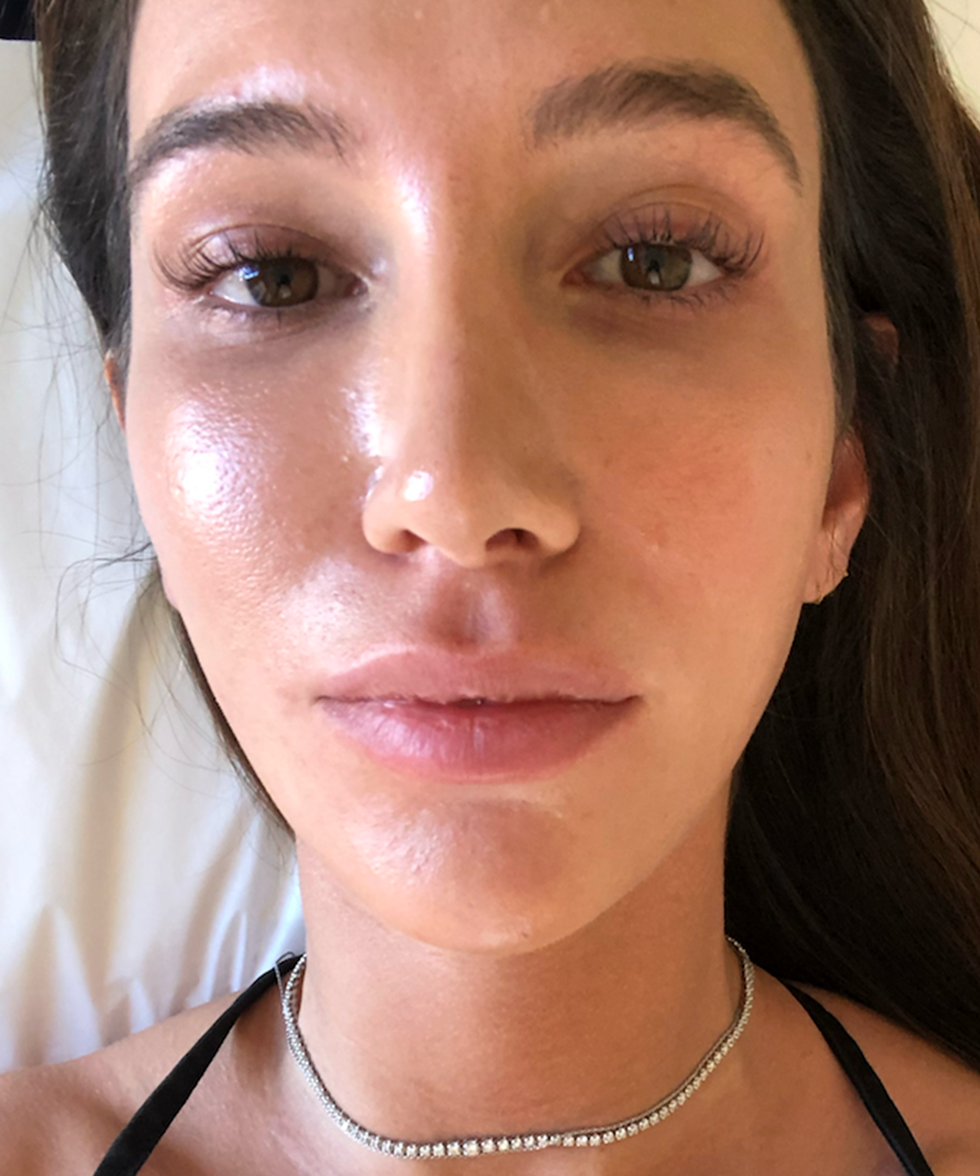
So I made an appointment with a permanent makeup artist who was kinda ~known~ in the beauty sphere — she had impressive online coverage, lovely looking before-and-after photos, and her studio was brightly lit, lofty, and beautiful. Everything just felt right. She handed me a mirror and explained that she would first numb me up with topical lidocaine for 45 minutes, then lightly trace over the entire surface area of my lips, including the borders, and — most importantly — that it wouldn’t hurt a bit.
Usually, at this point in the appointment, your permanent makeup artist would discuss shade preferences with you—some people want lip blushing to fully change their natural lip colour, while others want it to lightly define their lip shape or fill in some faded areas. But I didn’t know that at the time. I didn’t know to bring reference photos, or to show her my favourite lipstick or lip liner, or to discuss what I didn’t want at the beginning of the appointment, because she never told me to. So when she blended her own “go-to shade” without my input, I trusted her. And that was the part that now makes me cringe most about the whole procedure—even more than the pain.
Despite everything I had read and heard (“it feels like little scratches!” and “it’s not bad at all!”), my treatment hurt — a lot. For reference, I have an unusually high pain threshold: I open beer bottles with my front teeth, and I've had surgery on my ear while I was awake and watching. But during the lip-blushing session, my eyes were watering like an unruly tap. "If she goes over the right side of my upper lip again, I might actually die," I thought to myself. At that moment, I realised I hadn't cleared my Chrome history. Only the adrenaline from thinking about someone discovering how often I Google "alpacas after a haircut" kept me going.
I learned later that feeling such intense pain was, like most of my lip-blushing experience, completely abnormal. “Lips are considered a sensitive area, but most of my clients don’t complain about pain at all,” says LA-based permanent makeup artist and educator Stella Fixman, who noted that pain was the first red flag. “The technique itself works on the outermost layer of the dermis, so if you’re experiencing pain, it’s a sign that the artist is likely pressing too hard and going too deep.” At most, she says, lip blushing “should only feel like light scratching of the skin.” I, however, was in so much pain, even after lidocaine, that I was contemplating tapping out while my limbs were still mobile.
"You'll be restaurant ready by the end of the session!" the permanent makeup artist declared almost two hours (!) into my treatment. And that, according to Fixman, was the second red flag. “I never work on a client — as in, needles-on-skin work — for more than one hour,” she says. “Everyone’s skin is different, but what I’ve learned from years of experience is that most lips start to swell at the one-hour mark, and it creates too much trauma.”
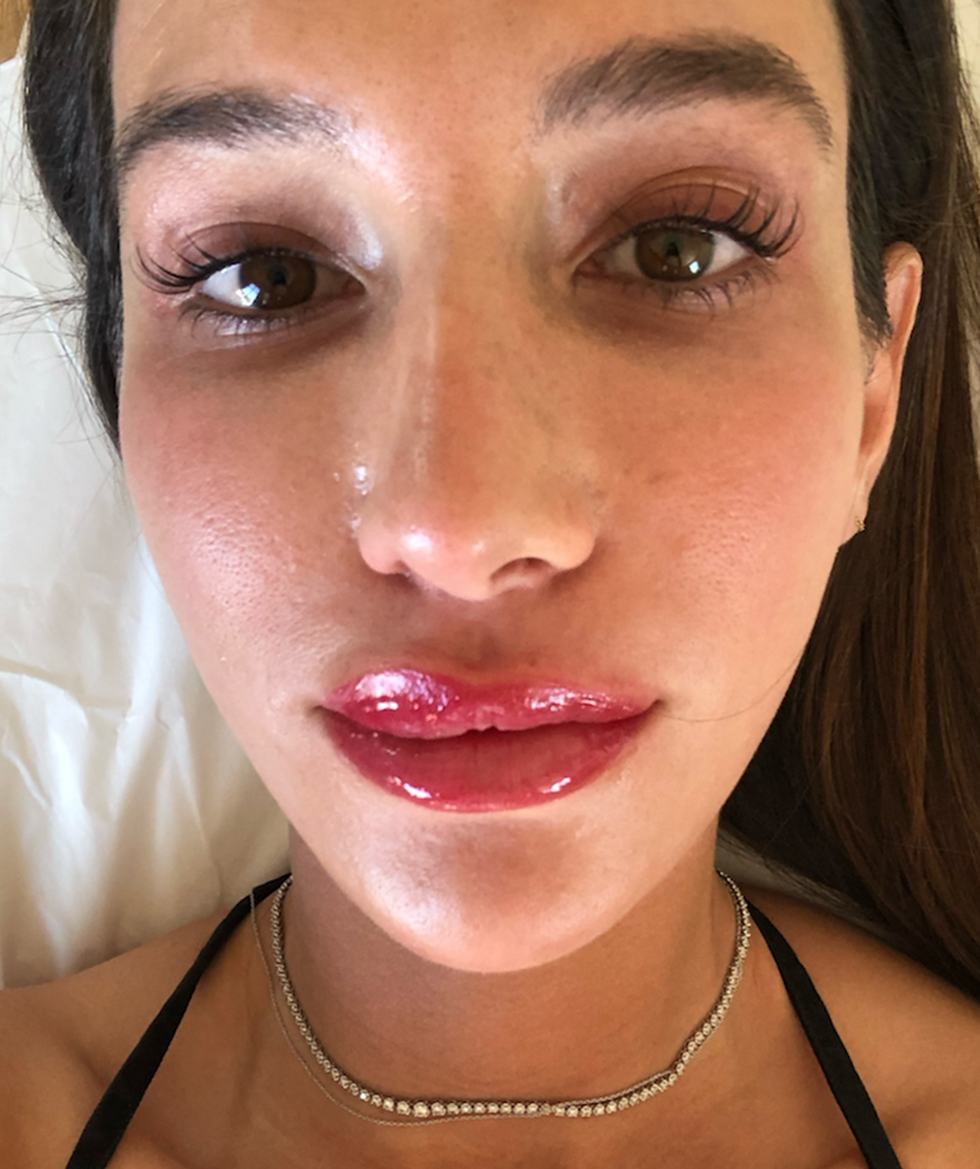
By the end of my appointment, I was so swollen on the right side of my top lip that it looked like I was having a severe allergic reaction. The heat and stinging sensation was unlike any tattoo, lip injection, or bee sting I’d ever had. The artist assured me everything was normal though. She assured me the healing phase would last only one week and sent me home with a custom ointment that would help with any dryness and shedding over the next few days. I took an Advil and tried not to panic.
During the recovery, I expected to look like I had just gone a little heavy-handed with my lip liner. Instead, my lips were more inflamed than a cherry-red Rosso Corsa. Fixman says that, on average, the initial lip-blushing pigment should start to fade by the third or fourth day (which is why the downtime for the treatment is usually so minimal), but my lips stayed red for ten full days, until the pigment started to fade off in uneven patches.
“It’s not supposed to look like that,” said a friend who had gotten lip blushing the year prior. She pulled up photos of her healing process; it looked nothing like mine. I called my permanent makeup artist in a panic. She assured me everything was normal, but to come back for a touch-up in six weeks. And that, my friends, was the third red flag.
Though some artists do require follow-up appointments to check on the healing process (which is fine and good), Fixman says that secondary treatments — as in adding another layer of ink to your lips — is typically not necessary.
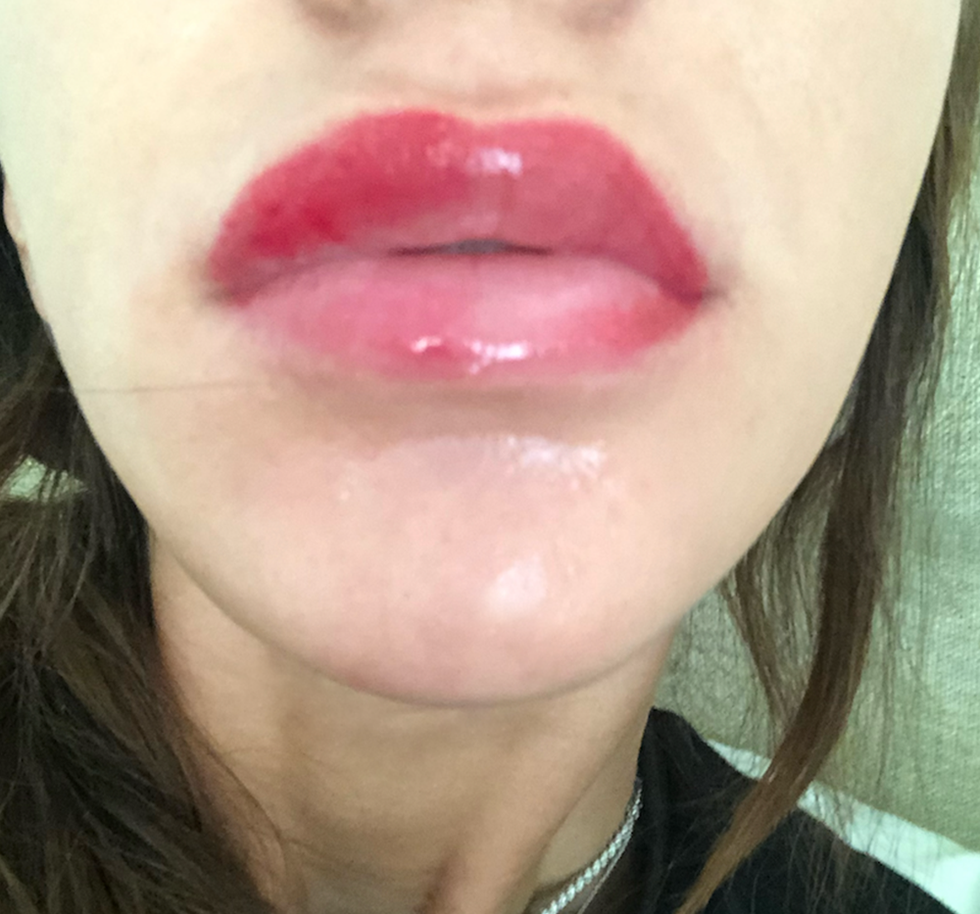
But, once again, I didn’t know any of this at the time. So when the artist swore that adding more pigment would correct all my problems, I believed her—and I was desperate. The treatment didn't hurt nearly as much as the first time, but my lips were race-car red again, and after another ten days of peeling, they somehow looked even more discoloured, uneven, and patchy than before. I was furious. I scoured the internet for photos of other patchy lip work. Nothing. Why was I the only unlucky soul with bad blushing?
The makeup artist asked that I return for a third time to fix the work she didn't believe was bad in the first place. This time, I reached out to Jonathan Cabin, MD, a board-certified plastic surgeon that I know and trust, who told me to steer clear of adding even more pigment. “One strong recommendation is not to chase lip blush that you don’t like with additional tattooing,” he said. “It’s bound to make the problem worse and more difficult to treat.” I listened to his advice.
Still, I wasn’t about to live with these nightmare lips—I needed a solution. I began looking for tattoo-removal lasers that were safe enough to be used on the lips. And fun fact: there really aren’t any. “Laser tattoo-removal anywhere on the body is typically a challenging, multi-treatment process, and one must proceed with particular caution in such a cosmetically sensitive area as the lips,” says Dr. Cabin, warning that your lips run the risk of getting even darker after treatment—or even black.
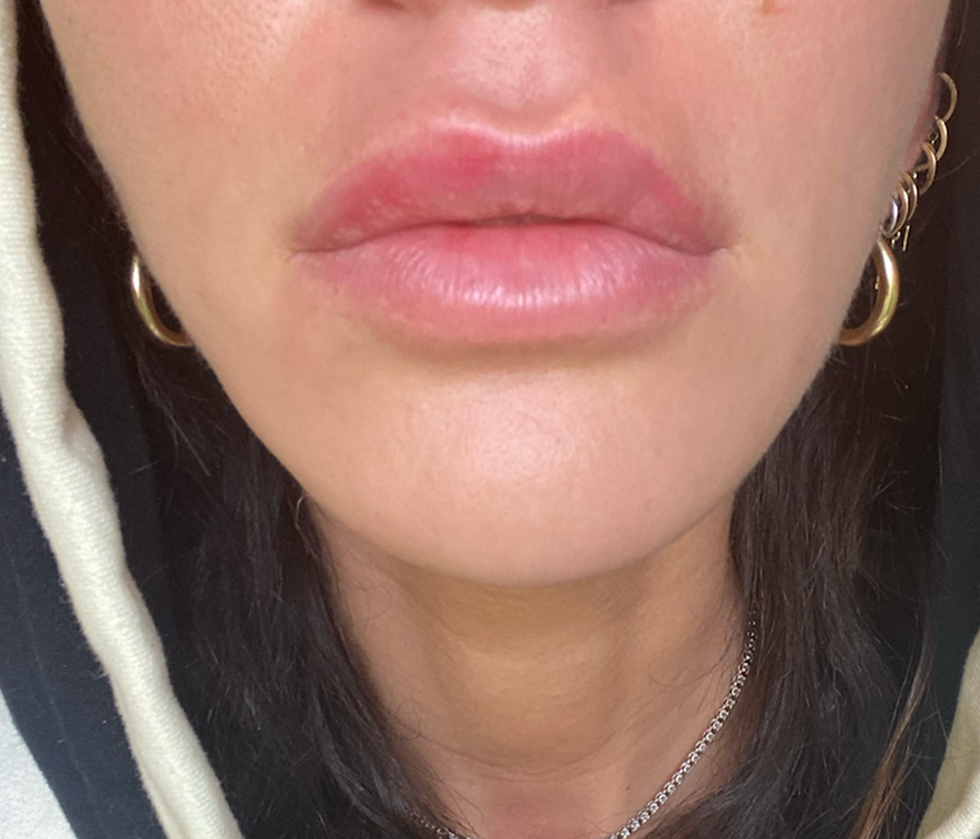
That’s not to say all laser removal is off the table when it comes to your lips, though. Since lip-blushing techniques and pigments can drastically differ from person to person, you may be able to successfully remove your blushing—but only a dermatologist or plastic surgeon can tell you for certain. And for me, it wasn’t an option. Instead, the only other solution I had was my old frenemy, Father Time. “These tattoos are generally not 100 percent permanent,” says Dr. Cabin. “They can fade over a two to five year period, so in most cases, it’s best to just wait it out.”
And that’s where I am today — waiting for the patches of pigment to fully fade from my lips. Looking back, I’m not mad at myself for deciding to do lip blushing; it's my job to try treatments and report on them (and besides, I'd never betray my former self). But it’s now more than a year later, and I still have blotchy lips. I wear lip liner every day so that the unevenness and shading isn't as noticeable.
If I could go back in time, I would insist on picking my own lip colour, and I would have also asked the practitioner to stop the service the moment I started feeling the intolerable level of pain that I was in (seriously, be your own advocate; if something feels wrong, say something). Even though I’ve come to terms with my solution-less reality, I’m still holding out hope for the approval of a new laser or some magical stem-cell treatment. Or, you know, the keys to a DeLorean going 88mph—whichever comes first.
Final thoughts
If you want to make your lips look more defined and flushed, lip blushing might be for you, as long as you do major research before picking a permanent makeup artist. And by research, I mean doing more than just reading the newest reviews online—DM their clients and ask for healed pics and about their experience, read through all the Google and Yelp reviews, and bring tons of pictures and references (like your favorite nude lipsticks) to show what you’re looking for. You can never be too prepared.
Meet the experts:
- Amy Koberling is a physician assistant at Baumann Cosmetic & Research Institute in Miami, FL. She is also the founder of The Skinthusiast, a blog where she educates readers on skincare and dermatology.
- Nika Randall
- is a senior lip blushing artist at Hairy Little Things in Los Angeles, CA
- Johnathan Cabin, MD, is a board-certified plastic surgeon at Skin DC in Arlington, VA.
- Stella Fixman is a permanent makeup artist and owner of Stella Ink in Los Angeles, CA. She offers lip blushing, microblading, brow shading, and more.
Why trust Cosmopolitan?
Beth Gillette is the beauty editor at Cosmopolitan with four years of experience researching, writing, and editing makeup and skincare stories that range from microblading to sunburned lips. She’s an authority in all skincare categories, but is an expert when it comes to lip blushing from interviewing dermatologists and permanent makeup artists.
Chloe Metzger is the deputy beauty director at Cosmopolitan with nearly 10 years of experience researching, writing, and editing skin, makeup, hair, and nail stories across print and digital, including dermaplaning and laser teeth whitening. She interviewed experts and researched reviews and first-hand experiences on lip blushing.
Tanya Akim is a beauty writer with more than three years of experience writing about skincare and makeup, including tattoo removal and the best face oils. She personally received a lip blushing treatment and spoke with experts.
Catriona Innes is commissioning director at Cosmopolitan UK. She is a multiple award-winning Commissioning Editor, who has won BSME awards both for her long-form investigative journalism as well as for leading the Cosmopolitan features department. Alongside commissioning and editing the features section, both online and in print, Catriona regularly writes her own hard-hitting investigations spending months researching some of the most pressing issues affecting young women today.
Beth Gillette is the beauty editor at Cosmopolitan, where she covers skincare, makeup, hair, nails, and more across digital and print. She can generally be found in bright eyeshadow furiously typing her latest feature or hemming and hawing about a new product you "have to try." Prior to Cosmopolitan, she wrote and edited beauty content as an Editor at The Everygirl for four years. Follow her on Instagram for makeup selfies and a new hair 'do every few months.

Chloe Metzger is the deputy beauty director at Cosmopolitan, overseeing the editorial content and growth strategy of the hair, makeup, and skin space on digital, while also obsessively writing about the best hair products for every hair type (curly girl here; whattup), and the skincare routines that really, truly work (follow her on Instagram to see behind-the-scenes pics of that magazine life). She brings nearly a decade of writing and editing expertise, and her work has appeared in Allure, Health, Fitness, Marie Claire, StyleCaster, and Parents. She also has an unhealthy adoration for Tom Hanks and would like to please meet him one day, if you could arrange that. Thanks.