Welcome to Cosmo's first-ever SPF week, a space dedicated to two very important things: 1. reminding you that sunscreen is the most essential step in any skincare routine and 2. sharing the best sunscreen recs to shop right now, according to four very picky beauty editors.
It’s 2025, and everyone knows how really freakin’ essential it is to incorporate sunscreen into their skincare routine, right? I mean, considering skin cancer is the most common form of cancer in the United States and is caused by, well, you guessed it: UV rays. Yet, on a daily basis, I’ve noticed that those around me either (a) don’t apply sunscreen enough or (b) don’t apply sunscreen at ALL. So I think it’s time to reiterate the SPF basics we should all know and practice: mineral vs. chemical sunscreen.

There seems to be a common-held belief that mineral sunscreen is the best choice, especially when it comes to dermatologists' recs. But is mineral sunscreen really better? What are the downsides to mineral sunscreen formulas, or the pros to opting for a chemical-based SPF? Let me break it all down.
Which is better: Mineral or chemical sunscreen?
Long story short: Mineral nor chemical sunscreen is "better" overall, since it comes down to personal preference and what SPF you'll actually use consistently. In the end, both dermatologists Annie Chiu, MD, and Rachel Westbay, MD, agree as long as you’re using sunscreen correctly, you’re doing it right. “The safest sunscreen is one you will use diligently and reapply without issues, no matter the formulation, and that is the end of the story,” says Dr. Westbay.
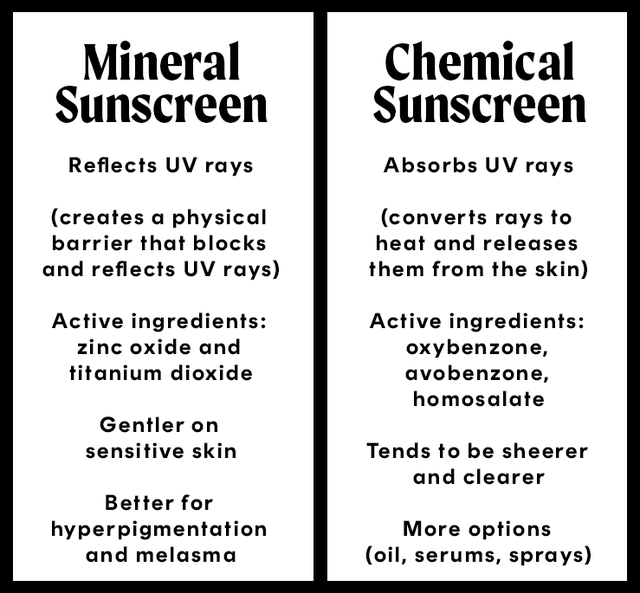
There are pros and cons to everything, and this especially rings true with mineral and chemical sunscreen. “It is normal to choose different SPF formulations to fit your activities, from daily use to water sports,” says Dr. Chiu. Here’s a breakdown, but keep reading for the full explanation.
What is mineral sunscreen?
Mineral sunscreen, also sometimes called physical sunscreen, “works similarly to a shield, sitting on the surface of your skin and deflecting the sun’s rays,” says Dr. Westbay. Mineral sunscreen contains the active ingredients zinc oxide and/or titanium dioxide, which are white-colored minerals that reflect light, meaning that mineral sunscreen is often the culprit of the infamous white cast on your skin.
But good news: If you want a mineral sunscreen without a white cast, you’ll be pleased to know that unlike the sunscreens of yesteryear, “there have been huge advancements in the way mineral sunscreens have been formulated and coded,” dermatologist Dendy Engelman, MD, has told Cosmo. “They don’t necessarily have the same light reflection anymore.”
These advancements are key considering mineral sunscreen “works for all skin types and is especially great for sensitive skin,” says Dr. Chiu, since it doesn't require a chemical reaction to work. Plus, zinc oxide on its own is anti-inflammatory and can be soothing on your skin. So if you’re unsure which sunscreen is best for your sensitive skin, go with mineral. Another bonus? This baby works immediately after application. Just slather it on, and you’re good to go.
Mineral sunscreen pros and cons:
Pros:
- Gentler on sensitive skin types
- Not as likely to cause breakouts and irritation on acne-prone skin
- Protects your skin as soon as you put it on
Cons:
- Can create a white-cast, especially on deep skin tones
- Formulas are usually thicker, so they can be harder to blend in
4 best mineral sunscreens, according to 'Cosmo' editors:

Odacite SPF 50 Flex-Perfecting Mineral Drops Tinted Sunscreen

Solara Suncare Guardian Angel Super Peptide Sunscreen Milk SPF 50

Lightsaver Activated Non-Tinted Mineral SunscreenSPF 33

What is chemical sunscreen?
Chemical sunscreens “work similarly to a sponge by absorbing the sun’s rays,” says Dr. Westbay. The UV rays are then transformed into heat and released from the skin, explains Dr. Chiu. “Chemical sunscreen contains one or more of the following active ingredients: oxybenzone, avobenzone, octisalate, octocrylene, homosalate, and octinoxate,” says Dr. Westbay.
Typically, chemical sunscreens are more water- and sweat-resistant, making them great for active lifestyles and also for most skin types, explains Dr. Chiu. “These formulations are typically more cosmetically elegant—meaning they rub nicely into the skin without a residue of chalky hue,” she adds. Because of this, chemical sunscreen can take on more of a lightweight, sheer appearance (and some can even be a totally clear SPF). But they need 15 to 30 minutes to fully absorb and take effect.
Keep in mind: There is a TON of speculation about whether chemical sunscreen is safe for use. But “we cannot definitively say that mineral sunscreens are 'safer' than chemical sunscreens,” says Dr. Westbay. And because there are no clinical studies that prove that there are any issues healthwise with the use of chemical sunscreen, it truly comes down to personal preference.
Chemical sunscreen pros and cons:
Pros:
- Formulas are lightweight and often totally clear
- Water and sweat-resistant, so great for sports and water activities
Cons:
- Can potentially be irritating for sensitive and acne-prone skin
- Might sting if it runs into your eyes
- Have to wait about 20 minutes for the product to absorb before it's effective for sun protection
- Not clean, if that's important to you
We love these chemical SPFs:


Black Girl Sunscreen Moisturizing Sunscreen Lotion SPF 30


E.l.f. Cosmetics Suntouchable Invisible Sunscreen SPF 35
Is mineral or chemical sunscreen better for acne?
There’s nothing worse than applying a product and your skin either (a) breaks out or (b) becomes itchy, red, or irritated. Unfortunately, this is a common occurrence for those of us with sensitive or acne-prone skin. That’s why it’s incredibly important to find a sunscreen that works for your skin without irritating it.
“Because one of the causes of sunscreen-related acne breakouts is a sensitivity reaction to chemical UV-blocking agents, chemical sunscreens may not be the most optimal choice for those with acne-prone skin,” says Dr. Westbay. That said, sunscreen formulations are damn impressive nowadays, and there are plenty of chemical sunscreens on the market specially formulated for acne-prone skin. It comes down to personal choice, but as always, a patch test beforehand is the safest way to go. When in doubt, look for non-comedogenic sunscreens, meaning they won't contain any of the common pore cloggers.
Your acne-prone skin will <3 these sunscreens:

DRMTLGY Anti Aging Clear Face Sunscreen and Facial Moisturizer SPF 45


Hero Cosmetics Force Shield Superlight Sunscreen SPF 30
Why is it so important to wear sunscreen?
This may sound like a question you don’t think bears repeating (because, uh, you’ve heard it a million times), but it absolutely does. “Failing to wear sunscreen puts one at risk of photodamage,” says Dr. Westbay. Photodamage is the ~fancy~ way of saying the changes that occur to the skin resulting from UV damage. She explains that these changes happen when UV light hits skin unprotected by sunscreen, causing DNA changes at a cellular level in the dermis (aka the deepest layer of the skin).
Sooo what does this mean? Well, it can take a long time for this damage to become visible (read: years)—but once it does, that’s when you can begin to notice common repercussions of UV damage (i.e., premature wrinkles, dark spots, uneven skin texture, and potentially even skin cancer).
Reason number 532 to wear sunscreen whenever possible: “UV exposure is not always related to how warm it is outside,” says Dr. Chiu. (Guess what?! That means you should also wear sunscreen indoors!) Dr. Chiu says that you should use a daily SPF of at least 30 no matter the weather. Basically, wear SPF daily and reapply often.
Meet the experts:
- Annie Chiu, MD, is a board-certified dermatologist and founder of The Derm Institute in Manhattan Beach, California. She specializes in non-invasive cosmetic dermatology and aesthetics.
- Rachel Westbay, MD, is a board-certified dermatologist at Marmur Medical and clinical instructor at Mount Sinai. She specializes in general and cosmetic dermatology, including injectables.
- Dendy Engelman, MD, is a board-certified dermatologist at Shafer Clinic in New York City. Engelman recently spoke to Cosmo about the best sunscreens with no white cast.
Why trust Cosmopolitan?
Beth Gillette is the beauty editor at Cosmopolitan with more than six years of experience researching, writing, and editing skincare stories that range from non-comedogenic sunscreens to sunburned lips. She's an authority in all skincare categories, but is an expert when it comes to the difference between chemical and mineral sunscreens (she's been asking derms about it for nearly a decade, after all).
Siena Gagliano was the associate editor at Cosmopolitan and wrote hundreds of skincare stories, like the best lip balms with SPF and the top lip plumpers, and feels especially knowledgeable about sunscreens as a skincare-obsessed beauty editor.
Beth Gillette is the beauty editor at Cosmopolitan, where she covers skincare, makeup, hair, nails, and more across digital and print. She can generally be found in bright eyeshadow furiously typing her latest feature or hemming and hawing about a new product you "have to try." Prior to Cosmopolitan, she wrote and edited beauty content as an Editor at The Everygirl for four years. Follow her on Instagram for makeup selfies and a new hair 'do every few months.