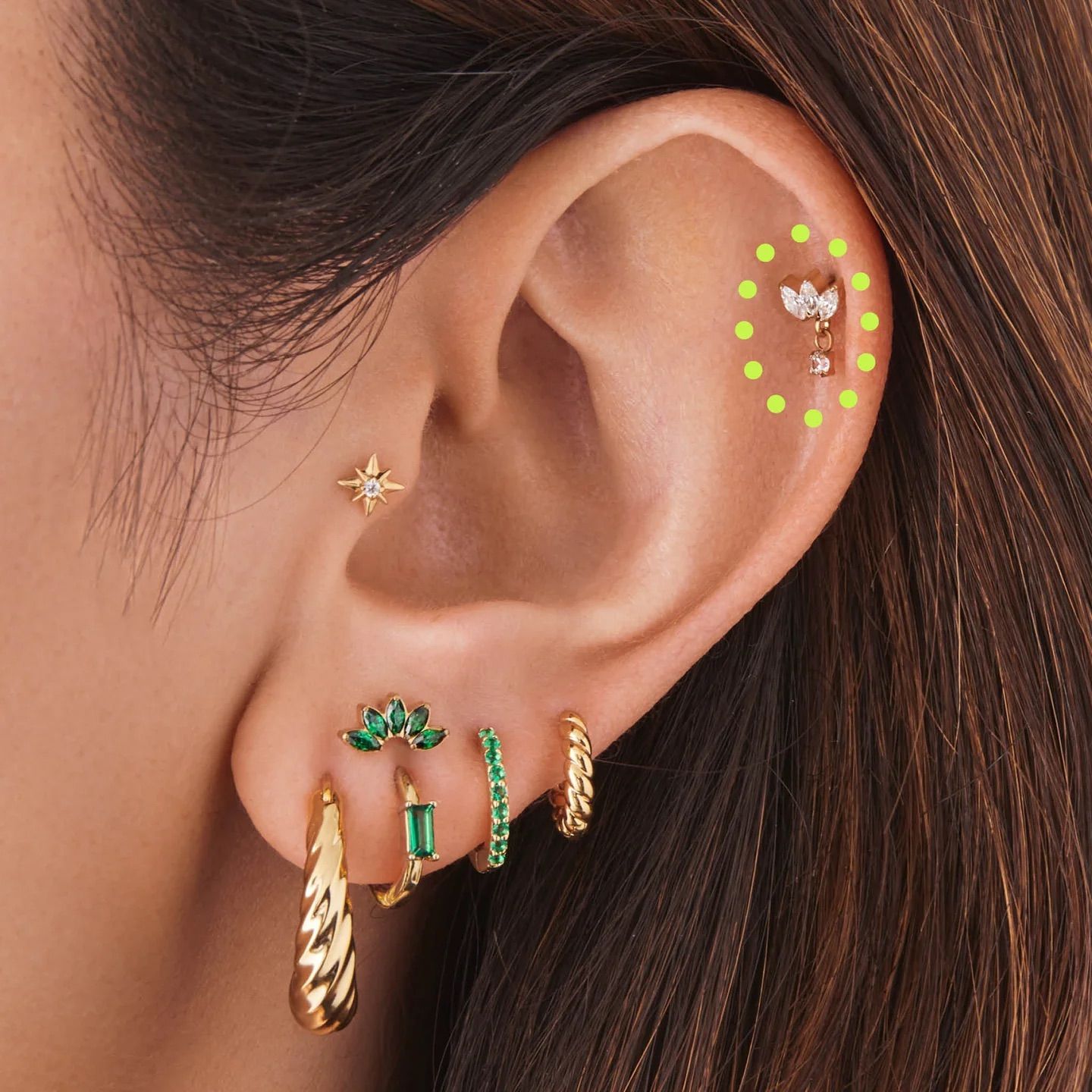
Whenever I see a picture of a curated earring design on the ’gram, I immediately want to drop all my money on a new ear piercing. There are so many fun earring types (hi, hoops, studs, climbers, dangles, huggies) and so many fun placements (s/o lobes, industrial, daith, tragus, conch), but my latest obsession is a helix piercing—aka your upper cartilage inclusive of everything between your earlobe and the top of your ear curve.
Because a helix piercing is located in an area with a lot of space, you can really get creative with what you wanna do, making it one of the best piercing options if you’re looking to play up your earring game. But because piercing involves puncturing your skin, it’s important to get all the facts, including safety information, and how to best optimize your healing results. Don’t worry, I gotchu. Then keep scrolling for the fun stuff—you know, all the s-t-u-n-n-i-n-g helix ear placements to bookmark for your next piercing appointment below.
What is a helix piercing?
“A helix piercing is located on the upper cartilage of the ear,” says Sam Isaacs, associate director of brand management at piercing parlor STUDS. Typically, helix piercings have four placements, Isaacs explains: classic, midi, flat, and forward-facing.

Other helix options include the vertical helix, contra conch, faux rook, or cat flap. These are alternative options for those with ears with a unique anatomy that cannot support the classic styles.
Helix earrings we <3...

BYCHARI Zodiac Stud Earrings


Mejuri Mini Hoop

Is a helix piercing painful?
Whether a helix piercing is painful is totally dependent on your personal pain tolerance and unique experience. “Because helix piercings are placed along the thicker parts of your ear cartilage, they can often be considered more painful compared to those that don’t involve cartilage,” says Isaac, adding that it’s important to remember that everyone experiences pain differently.
I have gotten a ton of different types of helix piercings, and in my personal experience, the pain feels like a quick pinch that dissipates in less than five seconds. However, if you’re getting multiple piercings in one session, I believe each piercing hurts more than the one before. This is likely because your body is still recovering from the first one.
The most painful part of a helix piercing, IMO, is the healing process, which can be made exponentially worse if you’re a side sleeper (hi, it me!). To allow your earring to heal correctly, it’s crucial not to sleep on it until after six to nine months. Doing so too early can cause friction, leading to irritation, swelling, and the piercing not healing properly.
How long does a helix piercing take to heal?
“Helix piercings can take three to six months to fully heal and sometimes even longer depending on the location,” says board-certified dermatologist Sara Hogan, MD. However, Isaac says that helix healing can take anywhere from six to nine months on average, with a very real possibility of it taking longer.
To optimize your healing results, Dr. Hogan recommends washing your hands before touching any of your piercings and keeping hair up and off of the ears to minimize the introduction of bacteria and dirt into the area. “Cleanse the piercing twice daily with saline or warm, gentle soap and water,” she says.
It’s common to get a longer earring post when you first get pierced—this accounts for swelling and should be changed out (i.e., downgraded) at around the four-week mark by your piercer *only*. When it comes to changing out your piercing earring, you need to ensure it’s fully healed, which will be around the six- to nine-month mark.
What to do if your helix piercing is not healing:
Dr. Hogan explains that because helix piercings involve the ear cartilage, infections can be more serious. In rare situations, you can develop something called perichondritis, or in simpler terms, an infection of the cartilage. If left untreated, more seriously, piercings can even lead to systemic infection, she says. This is why aftercare is so important and it’s vital to identify signs of infection early.
If you notice persistent redness, swelling, tenderness to touch, and yellow/green or foul-smelling discharge, see a doctor immediately, says Dr. Hogan. “If there is drainage, the area may be sampled with a swab and sent for testing to identify bacteria—topical or oral antibiotics may be prescribed.”
What is the best location to get a helix piercing?
The first step to ensure you’re setting yourself up for a piercing that heals correctly is to make sure the piercing establishment is reputable. According to the Association of Professional Piercers, piercing guns can cause significant tissue damage, so you should always opt for a piercing needle.
“When choosing a piercing location, we highly recommend avoiding places that rely solely on piercing guns," says Isaac, adding to always look for professionals who prioritize safe, sterile techniques and use high-quality materials. Piercing jewelry is typically limited to gold, implant-grade steel, and titanium, all of which do not harbor bacteria.
How do you take care of a helix piercing?
Luckily, helix piercings only need a standard aftercare routine, says Isaac. If you’re choosing a reputable place to get pierced, they will ensure you receive all information for proper maintenance. However, as a rule of thumb, Isaac explains that using sterile saline solution, rinsing your piercing with water, and avoiding sleeping directly on your fresh piercing(s) should do the trick.
Helix piercing aftercare must-haves!


Helix piercing inspiration
1. Hoops and a sparkle

✨ Get the look: Astrid & Miyu Triple Topaz Piercing Stud in Solid Gold and Essential 6.5 mm Hoop in Gold ✨
2. “Cat Flap” for a unique anatomy
✨ Get the look: STUDS 14K Twinkle Star Flatback Stud ✨
3. Tiny clusters
✨ Get the look: Astrid & Miyu Crystal Cluster Titanium Piercing Stud and Double Gem Piercing Stud in Solid Gold ✨
4. Pierceless cuff if you’re afraid of needles
✨ Get the look: Amazon Adjustable Clip-On Ear Cuff ✨
5. Minimalist
✨ Get the look: Rowan 14K Diamond & Emerald Flat Back Stud and CZ Trinity Studs 4mm ✨
6. Double piercing chain
✨ Get the look: Idyl Apollo Lab Grown Diamond 14K Chain Earring✨
7. Two-toned trend
✨ Get the look: STUDS Two-Tone Moon Stud and Moon x Star Reversible Flatback Stud ✨
Meet the experts:
- Sara Hogan, MD is a board-certified, fellowship-trained cosmetic dermatologist based in Washington, D.C. She is an assistant clinical professor in dermatology at The George Washington University School of Medicine and Health Sciences.
- Sam Isaacs is the associate director of brand management at STUDS, a nationwide piercing parlor and earring store that offers needle-based piercings and a wide selection of earrings.
Why trust Cosmo?
Siena Gagliano is the associate editor at Cosmopolitan and has four years of experience writing about beauty, fashion, and lifestyle news. She’s an expert at researching and writing beauty stories, like how to remove a blackhead and the best hair-growth oils. She regularly works with the industry’s top dermatologists and piercing experts for all the up-to-date piercing safety information, aftercare instructions, and best practices.