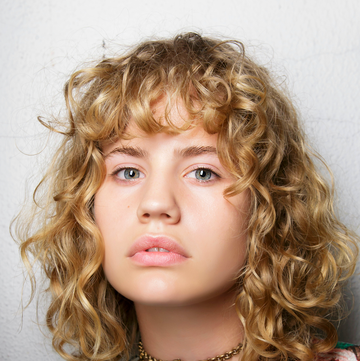
Having curly hair is like waking up to a surprise every day. At least it is for me. Some days I’m lucky enough to have perfectly coiled ringlets and on others beachy waves—without ever touching a hair tool. But my least favorite is when I have both in different spots on my head, along with tufts of frizz begging to be smoothed, making it tough to get my hair semi-uniform.
Turns out I’m not alone. “Most people with curly hair have multiple curl patterns,” says celeb hairstylist Clariss Rubenstein. So how do you know which to cater to? “Focus on the tightest or most fragile curls—they need the most moisture and protection,” Rubenstein says.
Another element that’s majorly helpful is knowing which curl type you are, even if it’s more than one. The curl typing system helps you identify and style your specific curl type based on texture. The straightforward method uses numbers 1 through 4 to classify hair types, with letters A, B, and C to further break down curls within each hair type for more precision. The numbers identify the texture: 1 is straight hair, 2 is wavy, 3 is curly, and 4 is coily. Then the letters signify the subcategories, which identify the diameter of the curl pattern: A is the widest, B is medium, and C is the smallest, so 2A is loose waves and 4C is tight coils.
By knowing your curl type, you’ll be able to determine exactly what your hair needs and how to best pamper and style it. That’s why I went to the pros to help you learn how to identify your curls, learn everything you need to know about your curl type, and discover the best curly hair products for you.
How to determine your curl type:
Curls are divided into nine curl types, from 2A to 4C. “It's a way to identify curl diameter and possible attributes like porosity, behavior, and shrinkage,” says hairstylist Jeannetta Walker-Rodgers. “Accuracy is debatable as there is no one-size-fits-all approach to identify curl types; everyone’s hair and its needs vary immensely.”
The best way to identify your curl type is to wash your hair, skip the styling products, comb while wet with a wide-tooth comb, and let it air dry. “Waves that barely bend are 2A, tight spirals are 3B, and densely coiled strands are 4C,” Rubenstein says. “Your hair may have a mix of types, but whatever the dominant pattern you see, that's considered your curl type.”
Type 2 waves:
What are the characteristics of type 2 curls?
Type 2 hair is defined by waves with a subtle S-shape. It ranges from fine to coarse hair and includes loose and thick waves. Typically, Type 2 waves can hold their shape but often require some finessing to smooth and prevent deflation. “They are larger in diameter,” Walker-Rodgers says. “They fall longer and flatter from the root and can lack volume and curl at the root.”
How should you take care of type 2 curls and enhance natural texture?
Air drying is this texture type’s friend. You can use your hands to scrunch hair into waves or wrap small pieces of hair around your fingers to create big S-waves. “Use hydrating lightweight products,” Walker-Rodgers suggests. “Layers can help with enhancement and volume.”
2A


Loose, barely-there waves are the main characteristics of type 2A curls. “They tend to get oily at the roots but frizz at the ends,” Rubenstein says. “Use lightweight products and avoid heavy creams. A spritz of leave-in curl cream helps keep waves soft and touchable without weighing them down.” She recommends using a curl-defining shampoo, conditioner, and leave-in cream or light mousse.
2B

2B waves are more defined, with a natural S-shape. “They’re prone to frizz, especially in humid climates,” Rubenstein says. “Use curl cream or mousse to define waves without stiffness.” If you prefer heat styling over air drying, use a diffuser when you blow-dry to enhance natural texture.
2C

These waves are thicker and fuller, with some loose ringlets. “They need more moisture and frizz control,” Rubenstein says. “Prep with a detangling spray, hydrate with a creamy conditioner, then define with a curl cream or gel. Scrunch while damp for best results.” A leave-in conditioner can also help hydrate this drier wave type.
Shop these top-rated picks for type 2 hair:

Nexxus Curl Define Shampoo


Type 3 curls:
What are the characteristics of type 3 curls?
Type 3 encompasses curly hair, ranging from loopy S-pattern curls to tight ringlets. “Hair starts to spiral, is medium in diameter, and starts to expand out from the head, providing volume,” Walker-Rodgers says.
How should you take care of type 3 curls and enhance natural texture?
For wet styling, using the finger coiling method is best, while for heat styling, opt for a diffuser on low airflow and high heat. “Use hydrating medium-weight products that have hold for definition that help to prevent frizz,” Walker-Rodgers says.
3A


Loose, springy curls with a defined S-shape sum up 3A curls. “They shine easily but can frizz at the ends,” Rubenstein says. All about nourishment, never skip conditioner. “Use curl cream on damp hair combined with a few pumps of oil,” Rubenstein says. Type 3A curls tend to be finer, so opt for lightweight products that won’t weigh curls down. That also means they can struggle to retain their shape, so use a curl refresher spray to bring them back to life when needed.
3B

“Tighter, springy ringlets that need more hydration shrinkage is common, and frizz can be an issue,” Rubenstein says. “Deep condition weekly, use leave-in cream for definition, and detangle gently with a wide-tooth comb.” Since this curl type is prone to dryness, shop for products that contain humectants, like glycerin and hyaluronic acid, which will keep hair hydrated and curls intact, plus reduce frizz.
3C


“Tight, corkscrew curls with lots of volume, these curls are fragile and need consistent moisture,” Rubenstein says. “Hydrate with rich conditioners, detangle carefully, and protect at night with a satin bonnet.” Using a leave-in conditioner designed for curls will help with moisture and curl retention.
4 must-try picks for type 3 curls:

Joico Curls Like Us Define & Seal Curl Defining Gelee


Type 4 coils:
What are the characteristics of type 4 curls?
Though the texture can range from fine to coarse, type 4 hair is coily. “It’s a very tight spiral and at its tightest it can resemble a zig-zag pattern,” Walker-Rodgers says. “It has the most shrinkage and can shrink up to 80 percent of its length. It grows in round, up and out of the scalp, and has the most volume.”
How should you take care of type 4 curls and enhance natural texture?
“Type 4 hair usually needs to be babied,” Walker-Rodgers says. “This type can be very sensitive to environmental and mechanical damage, like combing and brushing, so the tools you use really matter.” Naturally drier and sponge-like, type 4 hair craves hydration to smooth curls to prevent frizz, so hydrating creams and gels will help. Try layering in a leave-in, oil, and a cream to seal in moisture and hold your style.
4A

“Soft, springy coils with an S-pattern,” is how Rubenstein defines 4A hair, which has small, tight coils. “Shrinkage is significant, and moisture is key. Co-wash or shampoo gently, follow with a rich conditioner, and use a leave-in cream or butter to seal moisture and keep coils soft and defined.” You can also swap conditioner with a rich hair mask. To prevent breakage, sleep in a silk scarf or wrap.
4B


For 4B expect Z-shaped, zigzagged, tight coils that are more angular. Hair tends to be more dense but not as sharply defined, though a pattern is obvious, and major shrinkage can make hair appear shorter. “4B hair is fragile and prone to breakage,” Rubenstein says. “Hydrate generously, detangle carefully, and use protective styles when possible. A leave-in cream is essential.”
4C

This hair type experiences the most shrinkage. “These are the tightest, most delicate coils, often with little visible curl definition,” Rubenstein says. “Focus on moisture, protective styles, and gentle detangling. A leave-in cream is perfect for softening and defining fragile coils.”
Stylers we <3 for type 4 hair:

Curlsmith Curl Quenching Conditioning Wash


FAQ:
Why are curls divided into nine curl types?
“Curls are categorized from 2A to 4C to help everyone understand their unique texture,” Rubenstein says. “Type 2 is wavy, 3 is curly, and 4 is coily. The letters A, B, and C show how tight or loose the curl pattern is. Knowing your curl type makes it easier to choose products, techniques, and protective styles that actually work for your hair.”
Is it common to have more than one curl type?
“Yes, it is very common,” Walker-Rodgers says. “You shouldn’t prioritize one over the other, but care for all.”
What is the best way to care for curls and prevent breakage?
“Hydration and gentle handling are key,” Rubenstein says. “Use shampoos and conditioners focused on caring for curls, follow with a moisturizing conditioner, and detangle with your fingers or a wide-tooth comb on wet hair. Avoid heat overuse and sleep on a silk pillowcase or with a bonnet to protect your curls.”
Using lots of water and water-based care and stylers also helps. “Don’t skip out on restructuring; how much depends on the texture (finer strands need more structure, as it’s more susceptible to damage and breakage), overall health of the hair, and if it’s chemically treated,” Walker-Rodgers says.
Meet the experts:
- Clariss Rubenstein is a Nexxus partner and celebrity stylist based in Los Angeles, CA. Her clients include Jennifer Garner, Dakota Fanning, Mindy Kaling, Kaley Cuoco, Yvonne Strahovski, Leighton Meester, Allison Williams, and Alison Brie.
- Jeannetta Walker-Rodgers is the Joico global technical director. She specializes in hair styling, coloring, and extensions and is based in Chicago, IL.
Why trust Cosmopolitan?
Celia Shatzman (she/her) is a Brooklyn-based journalist who has covered beauty for two decades and has had curly hair even longer. She interviewed experts and made product selections based on their output and her personal testing experiences, sharing many of her favorites that have kept her curls defined and frizz at bay.
Celia Shatzman (she/her) is a Brooklyn-based writer and editor who has penned stories on topics ranging from beauty to fashion, travel, celebrities, health, entertainment, finance and more. A graduate of the Medill School of Journalism at Northwestern University, she is a beauty and style contributor at Forbes and her work has appeared in New York, Cosmopolitan, WWD, ELLE, Conde Nast Traveler, Afar, Travel + Leisure, Women’s Health, Marie Claire, Byrdie, Refinery29 and NYLON, among others.