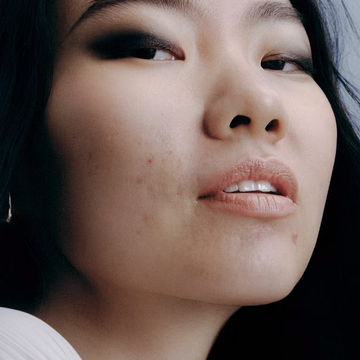
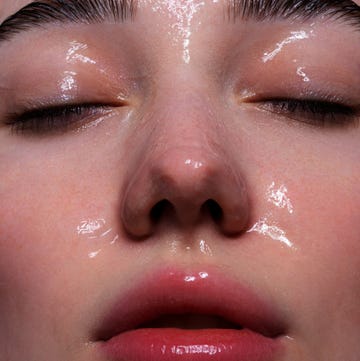
For about two weeks of every month, I look hella ugly. I don't mean it to sound self-deprecating or as though I'm fishing for compliments. It's honestly just a fact. My skin breaks out, my face is puffy, and my skin tone looks dull. And I'm not the only one. Just search TikTok: There are hundreds of videos about the "luteal phase uglies," referencing the luteal phase, the last two weeks of your menstrual cycle before your period. People ask, "why do we look ugly in luteal phase,” “luteal phase body” (derogatory), and my personal favorite, “why do I hate my bf during luteal phase." Guess I'm not alone!
But there's actually some science behind it, according to the three dermatologists I asked when my own luteal phase had me questioning a face transplant (kidding... kinda). What happens to your body during your luteal phase is precisely why your skin tends to freak out, resulting in acne, dryness, and inflammation. Then, I asked them exactly how you should take care of your skin during the luteal phase to prevent the dreaded uglies.
Jump to:
What is your luteal phase?
The menstrual cycle is the 28 (ish) day process of hormonal changes that prepares a woman’s body for a potential pregnancy, and the luteal phase is the back half of that menstrual cycle. Lasting about two weeks (but can be any amount of time between 10 and 17 days), this phase starts right after ovulation and ends the day before your period starts.
More science-y: During your luteal phase, the egg released during ovulation travels to the uterus, and the follicle that released the egg changes into a structure called the corpus luteum (which is what makes the uterus a viable environment for a developing pregnancy). If the egg doesn’t get fertilized in that cycle, the corpus luteum dissolves, and the uterine lining is shed—aka you get your period.
Why is my skin bad during the luteal phase?
“Estrogen helps improve skin elasticity and hydration,” explains dermatologist Toral Vaidya, MD, “and progesterone can increase sebum production, leading to breakouts, sensitivity, and skin barrier damage.” Super simplified, higher estrogen levels = good skin and higher progesterone levels = worse skin.
In luteal phase, the hormone balance is unfavorable for your face. Progesterone levels are on the rise as it’s produced by the corpus luteum, and estrogen levels are on the decline since the drop in estrogen is what eventually triggers a period. TL:DR: The combo of increased sebum production and a weaker, drier skin barrier creates the perfect storm for clogged pores, inflammation, and skin sensitivity.
When is your skin the best in your cycle?
The follicular phase, which immediately follows your period, is when skin is likely to look its best, healthiest, and dewiest. “This is when people tend to notice improvements in their skin radiance and complexion,” says Dr. Vaidya. In this phase, estrogen levels are on the rise to prepare the body for ovulation, and testosterone and progesterone are lower.
Bonus tip: When going for a potentially irritating cosmetic treatment like a chemical peel, laser, or microneedling, consider scheduling it during the follicular phase. “That higher estrogen is going to assist in maintaining the function and integrity of the skin and help with healing,” explains Jill Chmilewski, RN, BSN, a nurse and certified health coach at Respin Health.
Does this all apply to people on hormonal birth control?
It depends. Generally speaking, birth control pills contain synthetic hormones that basically flatline natural hormone production. With artificially mediated hormones, “you’re not going to have the signals and reactions that you would normally get if you were having a regular menstrual cycle,” says Chmilewski. But that doesn’t necessarily mean birth control is foolproof for treating acne or other skin issues you'd experience during luteal phase. Different birth control pills have various combinations of hormones, which can affect the skin differently.
There are birth control pills that are FDA approved for treating acne, but dermatologist Angela Lamb, MD, notes, “this is not the case for all birth control, since certain ones, like a progestin-only pill, for example, sometimes worsen acne.” The takeaway? It’s a little more medically complicated than one-size-fits-all, so be sure to seek guidance from a board-certified dermatologist who can tailor your treatments to your unique skin concerns.
How to avoid breakouts during your luteal phase:
It’s boring advice, but the things that are good for you are also usually helpful for your face. Getting enough sleep, gentle exercise, and healthy eating all support your skin resilience in luteal phase—or, at least, don’t contribute to the conditions that worsen breakouts. “Avoiding alcohol can be helpful because our liver is very intensely involved in breaking down hormones and making sure they stay balanced,” adds Chmilewski. Being more conscious of actions that introduce bacteria directly to your face—like sleeping on an unwashed pillow case or using dirty makeup brushes—is also a good idea.
How to help skin during your luteal phase:
Knowing that the hormonal fluctuations that happen during luteal phase can trigger increased oil production and higher skin sensitivity, it’s easier to create a thoughtful skin care routine that addresses those concerns specifically. When sebum production is in overdrive, you want to decrease the amount of pore-clogging bacteria on the skin and increase cell turnover to unblock your pores. The tricky part is to do that without drying out or irritating the skin, so proceed with a light, loving hand.
As a first step, Dr. Lamb recommends Neutrogena Fragrance-Free Acne Wash as a one-two punch for cleansing and exfoliating thanks to the 2 percent salicylic acid in the formula. Gentle chemical exfoliation is your friend and the key to getting rid of dead skin cells and sebum, so be thinking AHA/BHA serums, not physical scrubs. We love Sofie Pavitt Face Mandelic Clearing Serum, which, in addition to its clearing and smoothing properties, includes panthenol for skin barrier protection. Overly stripped skin will actually send a signal to your body to produce more oil to overcompensate, so an oily complexion still needs hydration. Gel moisturizers, like Dieux Skin Air Angel Gel Cream, usually fit the bill as they are lightweight and tend to be oil-free. You might also want to try swapping your regular facial mist with an anti-inflammatory and antibacterial hypochlorous acid spray like Tower 28 SOS Daily Rescue Facial Spray.
For active breakouts, Dr. Vaidya recommends hydrocolloid pimple patches because they absorb excess oil and (if you’re anything like me) stop you from picking at your face and possibly scarring. It’s choose your own adventure on the pimple patch market now. You can go nearly imperceptible with a clear patch like Hero Mighty Patch Invisible+ Patch or rock ’em as an accessory, like the colorful emoticon Dr. Idriss Patch It Rescue Pimple Patches, and take luteal phase face in stride.
Meet the experts:
- Toral Vaidya, MD, is a board-certified dermatologist in New York, NY.
- Angela Lamb, MD, is a board-certified dermatologist in New York, NY. She's knowledgeable in both medical and cosmetic dermatology, including skincare products and supplements.
- Jill Chmilewski, RN, BSN, is a registered nurse and certified health coach at Respin Health. She's an expert in menopause and hormone health.
Why trust Cosmopolitan?
Sam Neibart is a freelance writer and editor who has been covering beauty over digital and print for nearly a decade. She reports on the ever-evolving landscape of trends, tastemakers, and technology in the industry and loves nothing more than helping friends and readers discover the beauty products that are best for them.
Beth Gillette is the beauty editor at Cosmopolitan with seven years of experience researching, writing, and editing skincare stories that range from reviewing the best toner pads to collagen face creams.
Sam Neibart is a freelance writer and editor who has been covering beauty over digital and print for nearly a decade. She reports on the ever-evolving landscape of trends, tastemakers, and technology in the industry and loves nothing more than helping friends and readers discover the beauty products that are best for them. Previously, she held editorial positions at NYLON and Harper’s BAZAAR. She currently lives in Manhattan and biannually experiences the strong urge to dye her hair a new color. Follow her on Instagram.
Beth Gillette is the beauty editor at Cosmopolitan, where she covers skincare, makeup, hair, nails, and more across digital and print. She can generally be found in bright eyeshadow furiously typing her latest feature or hemming and hawing about a new product you "have to try." Prior to Cosmopolitan, she wrote and edited beauty content as an Editor at The Everygirl for four years. Follow her on Instagram for makeup selfies and a new hair 'do every few months.