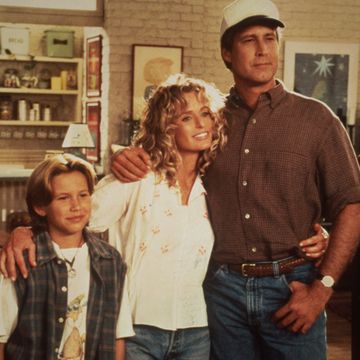
We gather here today to remember Rick and Chelsea, star-crossed lovers who died tragically in The White Lotus season 3 finale. The bittersweet ending saw them finally get on the same page, determined to be together forever, only to be killed in a shootout because Rick couldn’t let go of his past trauma. It’s a classic romantic tragedy: Rick is the instigator of his own downfall, and his need for revenge cost him the one person he’s ever really loved. And then it cost him his own life.
And the people are eating it up. Fans of the couple are already rewriting their ending on Twitter. Rick is played by Walton Goggins and the actor’s Instagram is full of sobbing emojis calling Chelsea and Rick “a love story.” Even my colleagues at Cosmopolitan got in on the action.

But I’m here to say: Despite this framing, Rick is no romantic hero. In fact, he kinda sucks.
Rick’s appeal isn’t hard to understand. He’s a man of maximum charisma who makes Hawai‘ian shirts look cool and mysterious. He’s gruff, sexy, and monosyllabic in a way that feels like a challenge. He’s The White Lotus’s Mr. Darcy, the most popular romantic archetype there is: strong, silent, rich, hot, and emotionally unavailable. Bonus points for those fleeting moments of softness that make you think maybe, just maybe, you can save him from drowning in his own despair.
Unfortunately, this is the same tired trope that conditions women, including yours truly, to accept casual cruelty as a sign of affection. It blurs the line between passive-aggressive flirting and condescension. And as much as I hate to admit it, it works. It’s what makes Gilmore Girls fans root for bad boy Jess even though he’s a habitual liar who ghosts Rory when she decides she doesn’t want to lose her virginity at some random house party. Or what makes me love The Summer I Turned Pretty’s Conrad even after he dumps his lifelong friend on prom night. We see a man like Rick and we think that with some love and nurturing, he can be free from his pain—and free to give us the full force of his affection. After all, what’s more romantic than a love that can actually save someone from a life of misery?

Still, when it comes to toxic masculinity, Rick is in a league of his own. Chelsea is bright, bubbly, and affectionate. Would a woman like this really fall for such an emotionally stunted dud. Sure, his inability to say “I love you” is part of his charm, but he doesn’t just not say it—he doesn’t show it. He’s constantly telling her that she’s an idiot, dismissing her declarations of love, her opinions, and even her basic request for support after being bitten by a poisonous snake. She heaps him with praise and words of affirmation, but what does he give her in return? Grunts and a 5-star hotel room?
After eight episodes, Chelsea’s boundless loyalty to Rick was unearned. But even as he shut her out, she couldn’t let go. She thinks of him as her child. He needed her, and she, like many of us, enjoyed being needed. But that’s really all the audience knows about her. Her character’s backstory. While we hear repeatedly about Rick’s terrible childhood, Chelsea’s trauma is never explored and, in the end, it feels like she exists only to serve Rick’s tragic arc.
But Chelsea has a past, too. She had parents, a childhood, hopes, and dreams. It should be absurd that such a key player of the season exists so superficially, but it’s also expected. Audiences have proven time and time again that they don’t care about the women who get hurt in service of a male hero (or anti-hero). Remember how Breaking Bad fans turned against Walter White’s wife Skylar because she *checks notes* didn’t want to be married to a ruthless drug dealer?
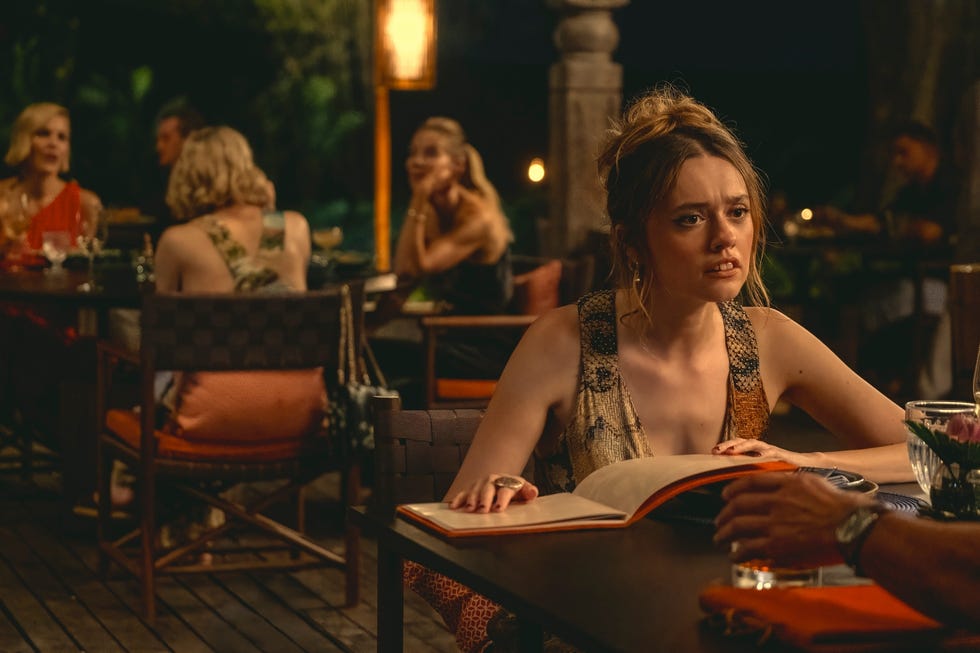
Ultimately, our obsession with making men like Rick heroes in pop culture has trapped us all into believing that when it comes to damaged men, emotional labor is exclusively a woman’s responsibility.
Even Amrita, Rick’s mild-mannered spiritual coach, bears responsibility for saving him (and the people he killed and the people they killed). In an “Inside Episode 8” featurette, showrunner Mike White said, “Had Amrita sat with Rick, maybe none of this would have happened.”
I hate to argue with the man who wrote and directed the finale, but—in the iconic words of Dakota Johnson—“that’s not the truth.” It’s not up to Amrita to save Rick from himself. And believing that just furthers the idea that women are responsible for fixing damaged (and even homicidal) men.
Even more infuriating, fans have pointed out that while Chelsea failed to “save” Rick, she might have saved the egomaniacal blue blood Saxon by giving him books on spirituality. So, even in death, Chelsea’s purpose is to help a cocky, sexist, white dude unlock his emotions, I guess.
Let’s let this trope die along with these characters. I know that the notion that a powerful woman’s love can stop men from violence feels rebellious in our patriarchal society—but Rick is no tragic romantic hero. He’s just…tragic.