Not every novel translates to television, but Daisy Jones & the Six managed to capture—and in some ways supersede—the aura of its source material. Based on the book by Taylor Jenkins Reid, Amazon’s new miniseries follows the rise and fall of a fictional rock band that happens to be inspired by Fleetwood Mac. With songs catchy enough to get stuck in your head and outfits that rival Almost Famous, Daisy Jones will become your next favorite show.
Between thousands of costume changes and a global pandemic, dressing the cast was a major undertaking, according to costume designer Denise Wingate, who got her start curating looks for ’90s classics like Cruel Intentions and She’s All That. Daisy Jones was a completely different animal. “I haven’t done a television series since Melrose Place,” she told Cosmopolitan. “I’ve only done features. And this was like doing a 10-hour movie.”
Below, Wingate reveals how she created the groovy looks seen on Daisy Jones & the Six.
What was your reaction when you were asked to be a part of the show?
I read the book and I was like, I have to do this. I grew up in L.A., I was sneaking out going to clubs with a fake ID when I was really young, so I completely knew the world. I had traveled as a stylist with the Bangles for a year when I was in my early 20s. I knew what it was like to be on the road.
Some of the costumes are reminiscent of what’s described in the novel. For example, Karen has a penchant for black turtlenecks. Was that intentional?
I am so happy you said that because I was so worried that the fans would be disappointed. I was trying to make sure that if there were specific things in the book that I at least stayed true to that. I just felt like it would really disappoint the fans if Daisy didn’t show up to that first recording session wearing a man’s shirt and cowboy boots.

What did your research and mood boards look like?
I tried to make it as authentic and real as possible without it looking too costumey. So I did a lot of research. I watched a lot of documentary films.
I had so many boards—every character had their own. For early Daisy, I started out with Linda Ronstadt in the early ’70s. For Suki Waterhouse, who plays Karen, it was Patti Smith, it was Suzi Quatro, Joan Jett, and then Marc Bolan from T. Rex because he was all glam. Camila was early Ali McGraw and then she morphed into Bianca Jagger. For the guys, I would have these boards of just bands: Deep Purple, Uriah Heep, Led Zeppelin, Jim Morrison. Billy was only Bruce Springsteen. That was it because that’s who I felt that he would be, somebody true to his roots.
Music was also a huge part of your research, right?
I would just listen to Classic Vinyl on Sirius XM. That’s all I listened to in the car, on the radio, in my office. Every time I would hear a song, I would go, Oh, who sings that? And then I would research the band. Now I feel like I’m an expert in that rock-and-roll era.
Daisy Jones takes place in two different decades. How did each time period influence the costumes?
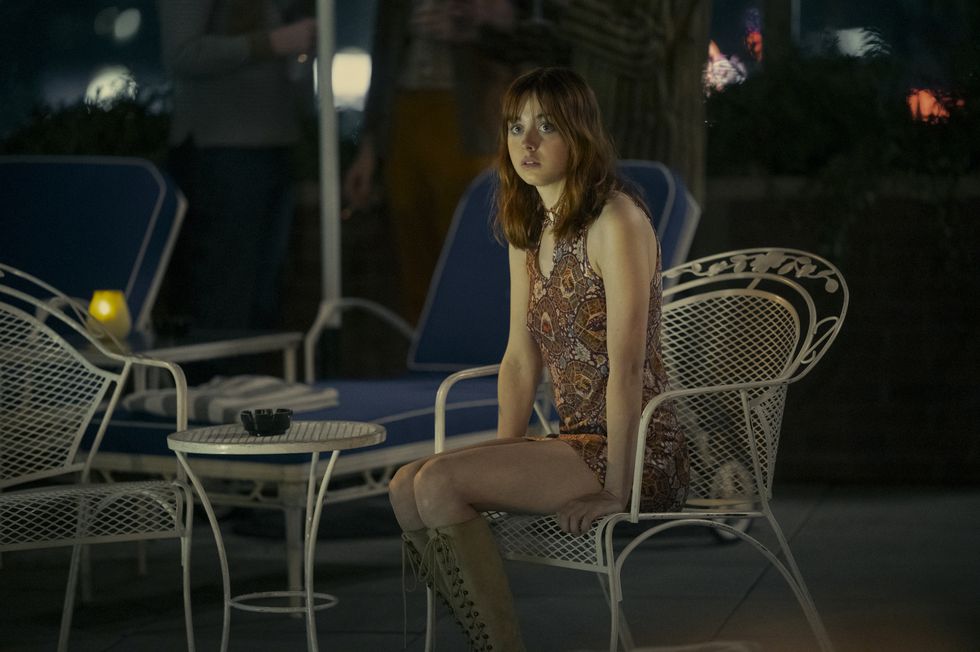
The cool thing is, we started in the late ’60s and then transitioned into the ’70s. We had a little psychedelic, a little mod for when Daisy goes to see the Byrds, and then it morphed into the Laurel Canyon rock-and-roll era, and then the inspiration became full-fledged stadium bands.
COVID-19 interrupted the production. How did that impact what you ended up using?
We had so much time. We shut down for so long. Our first fittings, I don’t think we knew who Daisy was. Looking back at the photos, we didn’t use half of that stuff. When Riley started to perform, we realized that if we used clothing that was flowy, she was more like a butterfly. We didn’t have that perspective in the beginning because she wasn’t performing yet. Once she knew how she was going to move, it influenced the silhouette that we were doing.
How did you source the costumes? Were they vintage, modern, handmade, or a combination?
It was everything: new, old, rented, made. It was kind of a mélange. I went to rental houses. I went to flea markets every weekend for a year. I would come home every night and just be online. I scoured every vintage site. I don’t think people realize this, but people in the ’70s were wearing vintage clothes. So a lot of Daisy’s pieces are from the ’20s and ’30s. The gold crocheted dress Daisy was wearing in the final concert, under that gold Halston cape, is from the ’30s.

Unfortunately, with authentic vintage pieces, they fall apart really easily. We were constantly mending and taking care of stuff. Daisy wears this little velvet 1920s bed jacket, and it ripped down the back in the middle of a scene. We had to tape it together!
I also used contemporary stuff. I used Free People and Levi’s a lot. If it felt of the period or like it was part of this world, I was happy to use it.
A woman named Love Melody made some stuff for me too. She made original leather pieces [back in the ’60s and ’70s], and she made two jumpsuits for Elvis. I had her make two long coats for Riley, one a patchwork leather-and-denim long coat and one a beautiful brown leather coat. I just felt like it was nice to have some authentic pieces in there as well, really from the day. I think Riley, who is Elvis’s granddaughter, got a kick out of that.

Daisy Jones & the Six (the band) is loosely based on Fleetwood Mac. How did their style inspire the show’s costumes?
For the Aurora album cover, we made this beautiful sheer chiffon dress for Daisy. There was a rock-and-roll photographer named Neal Preston who did this very famous photo shoot of Stevie Nicks wearing this white dress, and that picture was on my wall for so long. I was like, “We have to do this for Aurora,” so we painstakingly made this white dress. It was so beautiful. It had embroidered flowers on it and lace.
Mick Fleetwood and all his vests, that’s where it started with Warren. He wore vests all the time, and then all of a sudden, Warren became the vest guy. All of the drummers from that era were wearing vests, I think because it was easier to play, right?
In the final scene, Eddie is wearing a three-piece white suit, and I completely took that from a Lindsey Buckingham concert photo. There were a lot of rock-and-roll guys wearing white suits. Josh Whitehouse, who plays Eddie, was so game—I’m like, “Can I please put you in a white suit for this?”
Each character’s style evolves as the series progresses. Did that have anything to do with their individual storylines?
It did in the fact that they had more money. I mean, the only person who never changed was poor Billy, who was always wearing denim. I was constantly apologizing to Sam Claflin because everybody was coming out in these outrageous outfits and furs. He was such a good sport.
A lot of the coats were like armor for Daisy in certain situations where she didn’t want to be open to Billy or she was trying to protect herself. So we did a lot of coats, and those coats are fabulous.

There are a lot of characters in Daisy Jones. How did you keep track of everything?
It was confusing—literally, my head was spinning. There were thousands and thousands of changes. The closets were huge. I made paper dolls of all the characters and all of their fitting photos. Then I had giant boards with Velcro so I could move around the paper dolls to make sure that they all looked okay together. I needed visual organization.
Styles from the ’70s are making a comeback. How can viewers re-create the look of the costumes in their own wardrobes? Which silhouettes should they look for?
Flare jeans. There’s a pair of jeans that Riley is wearing when she’s walking down the Sunset Strip—it was by a company called Stoned Immaculate. They’re doing complete retreads of great vintage pieces. I personally have always loved a boho look; I’ll wear a caftan any day of the week. I think that never goes out of style. Cowboy boots and short shorts too.