Dolly Parton was already a legend in Nashville—as a singer and songwriter—before she made a move into the mainstream in the late ’70s. Parton moved to Hollywood, starred in the hit comedy, Nine to Five, with Jane Fonda and Lily Tomlin, and her movie career was launched. By the end of the ’80s, she had a string of movie flops and a disappointing TV show under her belt, but Parton was undeterred. In a conversation with Chris Chase from the October 1989 issue of Cosmo, Parton talks about her family, career, and how she couldn’t wait to get on the road with her band again. —Alex Belth, Hearst historian
I first met Dolly Parton in 1976. We were doing a piece for the New York Times Magazine, and I figured appearing in those pages would give me such credentials as an intellectual that Jean-Paul Sartre would be pestering me for a date. Dolly took the whole thing more lightly.

In those days, she was tooling around the South in her bus with a band full of relatives, playing what she called her git-tar and singing country music—much of it written by her—at theaters and fairs. I remember one show at East Burke High School, outside of Hickory, North Carolina. A fat guy was drinking out of a bottle in a brown paper bag and shouting raunchy but enthusiastic comments at Dolly in her yellow bell-bottoms, and she handled him so easily. “Now don’t you talk dirty,” she said, and he sank back in his seat like a guilty schoolboy. She was married to Carl Dean then; her best friend, Judy Ogle, was her secretary; and a man named Don Warden did her bookings out of Nashville.
Thirteen years later, everything’s changed, and nothing’s changed. Dolly’s a movie star, she’s skinnier than she used to be, but Carl is still her husband, Judy is still her right arm, and Don Warden is still figuring out her road trips. Because Dolly’s headed for the bus again. “It’s six years since I took off so ill and lost in my TV show and everything,” she says. “I’ve missed getting out where the real country fans are. I’m a gypsy at heart.”
But first, a word from her sponsors. Dolly’s new movie, Steel Magnolias, opens in November. Her new album, White Limozeen, is in the record stores; her new single, “Why’d You Come in Here Lookin’ Like That?” is all over the radio; her theme park, Dollywood, in Pigeon Forge, Tennessee, has just enjoyed its fourth summer season. This year, Dollywood features new rides, arts and crafts, clog dancing, cornbread and pumpkin butter, and The Kinfolk, assorted uncles and aunts and cousins performing at the Back Porch Theater, a replica of the two-room shack where Dolly was born. (The Dollywood Foundation gives scholarships to poor kids and provides health care in Sevier County.)
So Dolly is in New York to push all of the above, and one of her first stops is the cable show of disk jockey Bobby Rivers. On the air, Rivers quotes a lyric from “Why’d You Come in Here” about someone with “big ideas and a little behind.” “I’ve known you since I had little ideas and a big behind,” whoops Dolly. Rivers laughs and asks how long it takes to do her hair. “I don’t know how long it takes,” says Dolly. “I’m never there … my hair is in the next room.”
Rivers wants to know what Dolly would alter if she ran the world—Gregory Peck said he’d stop racism, Jodie Foster would stop pollution—and Dolly thinks a second. Then: “I’d like to see everybody with a bellyful of food and a houseful of furniture and a car.” Practical Dolly. Let others consider the big picture, her eyes is on the sparrow.
Show over, she’s out of there, on her way to Live at Five, a local NBC news program, where she tells the male cohost no, she doesn’t think having her ABC variety show cancelled hurt her career, and yes, she’s going on the road again. “I want to be at a truck stop at three in the morning,” says the man, “when you pull up and go into a greasy spoon.” (Men get giddy around Dolly. That same night, David Letterman tells her, “I’d like to see you sweating.”)
Later in the week, she hosts Saturday Night Live, acting in sketches, stomping in her high-heeled boots, picking at her guitar, pleased to be at the party.

I finally catch her alone at the Fifth Avenue apartment she rents with her manager, Sandy Gallin. Since neither of them really lives there—it’s just a place to light when one of them is in New York—the place has an impersonal feeling. Fat white couches, a big coffee table, some tired fruit. From the living room window, you can look down to The Plaza hotel and up to the Central Park skating rink.
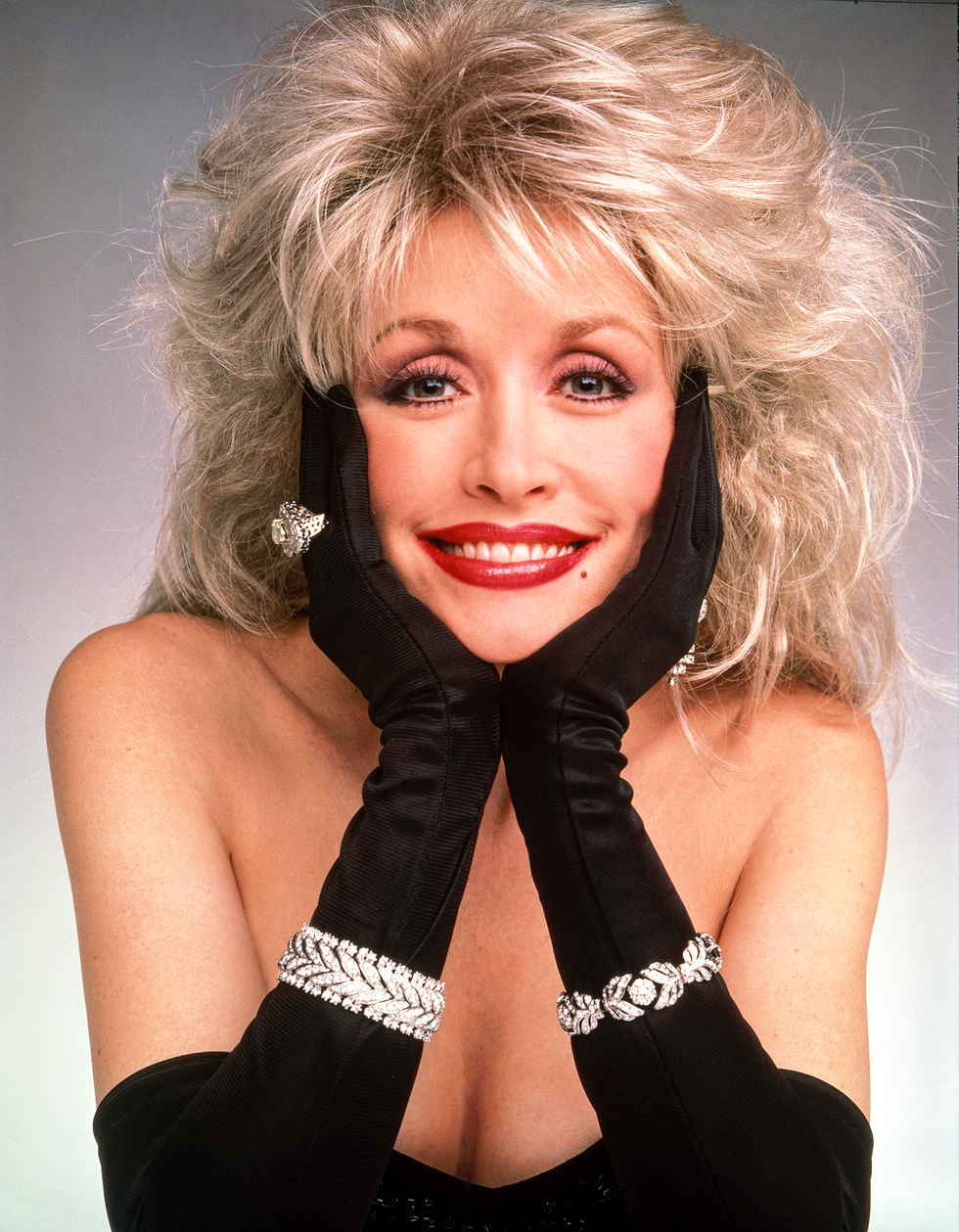
Dolly is wearing a hot pink T-shirt and fingernails that must be an inch and a half long. “I try to make positives out of my negatives,” she says. “If I got little short fat hands, I wear nails as long as my fingers; little short legs, I wear heels as tall as my legs; if the hair don’t do what I want it to, I wear the wigs. I’m very fair-skinned, so I love to wear makeup. Hey, look, what can I tell you, I’m a painted doll.” (In the autobiographical “White Limozeen,” she describes herself as “Daisy Mae in Hollywood,” and the image is apt. She is so guileless she can sing that she’s “the toast of Hollywood” and not irritate you.)
Now, she sits on the floor and talks. She’ll talk about almost anything but politics, which includes where she stands on abortion. “Don’t git me into marchin’ on Washington, and don’t even ask my opinion on it, ’cause I don’t have one.” About everything else, she has opinions aplenty. Fidelity, for instance. She believes fooling around can diminish a marriage. “Most people are not secure enough to handle that.” On the other hand, she thinks flirting is dandy. “I do what I do,” she says. “I don’t always tell what I do, I don’t always deny what I do either. I see people all the time that ring my bells, and if sometimes a man has made me sexy by flirting with me, then that’s usually all I need to feel like I’m still pretty. I’ve still got it, I’ve still moved somebody. And that somebody can still move me.
“I’m a flirt, I’m a tease. I always have been. I think that’s better than just runnin’ off and screwin’ everybody you come across and thinkin’ that you’ll find the answer in bed. I’m sure my husband does the same thing. He’s always tellin’ me about some girl—‘Oh, there’s the prettiest little girl works at the bank”—and I don’t mind that. But if somebody else came up and said, ‘You know, that pretty little girl at the bank and your husband…’ that might be a different story.”
Dolly met Carl Dean the day she arrived in Nashville from Sevierville, Tennessee. She came on a bus, the morning after her graduation from high school, because “I always wanted to be a singin’ star, and for a singin’ star, Nashville was the world.” When Carl approached her on the street—it was outside the Wishy-Washy Laundromat—she was wary. “I mean, that was somethin’ we was taught.” But Carl was serious. He hung around the house where Dolly was staying with her uncle, Bill Owens. He sat on the porch—“I wouldn’t let him into the house”—until he could convince her to come meet his parents. “’Cause he said he knew right the minute he saw me that that’s the one he wanted.”
Having been Carl’s wife for twenty-three years, Dolly says she believes in marriage, but shies away from advising others about they ought to do. Though, in the age of AIDS, she thinks “people should be careful who they git with. I think it’s nice to know—for your health—where the person’s been. On my TV show, some kid asked me, ‘Do you have any advice for teenagers today?’ and I said, ‘Yeah, just act like it’s rainin’ and wear your rubbers.’ It just popped out before I thought. I got some criticism, but that’s pretty much my advice to anybody havin’ sex.”
In Dolly’s view, relationships between men and women have “all got jumbled up. Society has always said men can’t cry, women do nothin’ but. Women are allowed to piss and moan all day, and the man ain’t allowed to say this or that. Women should have the right to do anything they can do, they should have equal chances, but I’m old-fashioned, I think it’s romantic for a man to treat you nice, to open doors. So if that makes me not as women’s-libbish as I ought to be, that’s not the point. We’re talkin’ about my opinion.”
She admits she’s been lucky. “I’ve never suffered for bein’ a woman myself. Even early in the days of getting’ into the music business, I think bein’ female helped me. I never had been harassed unless I’ve pretty much asked for it, and even when I was harassed, I had the kind of personality that could get out of it pretty easy.”
Personality and lethal weapon, in one case. Back in the ’60s, a busload of kids from Sevier County High School came to the New York World’s Fair, and Dolly and Judy Ogle peeled off from the others to go investigate Times Square. They were little girls with teased hair and too much makeup and all the dime-store jewelry they could hang on themselves—“We looked cheap,” Dolly says cheerfully—and a man accosted them. Dolly was packing a gun “for protection in the big city,” and when the man wouldn’t go away, she pulled it out. “Touch me again,” she said sweetly, “and I’m gonna change you from a rooster to a hen.”
She talks poetically about “understanding the true nature of a man,” but even while she’s understanding the guy, she’s got him in her sights, if only metaphorically, most of the time.
What sort of man appeals to her? “I like simplicity. Simplicity and intelligence. As far as the physical look, I’m old enough and I’ve lived enough to where I’ve been involved at some point with almost all kinds of men. Though in the early days, I was drawn to tall slim men because my father was tall and slim. My husband’s very tall and slim. I love that frail look, like Sam Shepard.”
Shepard, who plays Dolly’s husband in Steel Magnolias, was on location in Natchitoches, Louisiana, only briefly—“He did his whole part in about a week,” Dolly says—but he made a big impression. “Oh, he’s just so pretty to me, and he’s so good, so nice, so quiet. There’s stuff going on in there. You’d just like to climb down in and stay awhile and find out what all it is, but you know he’s got somebody and you’ve got somebody, and you ain’t got no time for climbin.’”
The ladies of the ensemble—Dolly, Shirley MacLaine, Sally Field, Daryl Hannah, Olympia Dukakis, Julia Roberts—were in Natchitoches for three months, and “got along really good.” What about Shirley MacLaine? Did she tell Dolly who’d she’d been in another life? “No,” Dolly says, “I just kidded with her. I said, ‘I don’t believe in reincarnation, and I didn’t believe it when I lived before either.’ I liked Shirley. I think Shirley and me were the most worldly of all, the most traveled and road-worn, and we had a mutual respect.

“I loved all the women. We did not fight over costumes because nobody was so beautifully dressed that it was a threat to anybody else, we did not fight over men because there were no men to fight over, we didn’t fight over who had the bigger trailer because we had ’em all exactly the same. Steel Magnolias represents strong Southern women; I play a beautician, and the life of the town is centered in her beauty shop. It’s based on a true story written by a boy named Bobby Harlin. It’s about his sister who died, and all the townspeople got to be extras in the movie. It was so strange, they’d come up and say, ‘Oh, yes, we were at the original wedding’ or ‘We were at the real funeral.’
“In any small town, there’s a great deal of gossip, and every day, we heard a new rumor. Supposedly, people were beatin’ on my door, tryin’ to come in, and it had got so bad I had to commute from Shreveport every day in helicopters, and not a word of that was true. We’d get hysterical. It was just because there were all those movie stars in that town, everything became a story, and some of the stories would get sold to the Enquirer and the Star. One day, somebody comes in with a paper that had a picture of Shirley MacLaine in one corner and Sally Field in another, and the headline says, ‘MacLaine Distraught Because Sally Field Tells Her to Shove It.’
“The whole rest of the time we were there, we’d all go around saying, ‘Oh, shove it, Shirley, just shove it.’”
Steel Magnolias gives Dolly a shot at a hit movie, which she hasn’t had since Nine to Five. What does she think went wrong with the screen version of The Best Little Whorehouse in Texas? As she understands it, she says, “The people who did it on Broadway were to produce and direct, and then Universal bought it and they didn’t want those people, and they kept buyin’ everybody out. People thought me and Burt Reynolds had teamed up and were causin’ problems, but I didn’t have the power to do that and I don’t think Burt did either. They asked me to write additional music, but I wish I’d never wrote a thing for it; it just became horrible to the point where I had no fun.”
Since Dolly also starred in Rhinestone (she had to sing with Sylvester Stallone), the question arises, would she want to make another Hollywood musical? “Well,” she says, “I have now done two musicals with two people that do not sing. To me, that’s stupid. Maybe if somebody put Kenny Rogers and me together, it could have been great, but I’m not so sure. I’m a little bit leery of musicals in Hollywood these days, the same way I am of variety television.
“Those musicals I made were not the kind I would have wanted to do, nor was my television show the show I had in mind. They drug people out of mothballs that hadn’t done anything in twenty years, since variety died of natural causes. I had imagined somethin’ more like Hee Haw, more country. I have no regrets. I’ll never apologize for tryin’ something, and I’ll do television again at some point in time. But it’ll be more carefully planned. And I’d be surprised if it’s done in Hollywood.”
In 1976, Dolly confessed to being careful with a buck. She told me then that she took nothing for granted. “People say, ‘Boy, it must be nice to be able to buy anything you want,’ but I just cannot hardly make myself spend five hundred dollars on a dress. And to this day, if I’ve cooked dinner at home, I will not throw nothin’ out because I can still hear Mama sayin’, ‘Ain’t that somethin’, you throwed that out, and all them kids overseas starvin’ to death.’”
It's the same now, she says, though she’s invested in houses in California and Tennessee. “I don’t have much trouble with real estate, because I can always resell that and make money, but for me to say I’m gonna buy a three-thousand dollar coat or a piece of jewelry for a large amount of money, I would still rather have a lot of cheap things. That will always be in me, from bein’ poor, from bein’ country. It’s like I think, Oh, my lord, I could buy food for several families a month with what I’ve paid for this stupid coat. My manager buys me fur coats and diamonds, I still buy pop beads and car coats. I’m still cheap.”
Cheap is relative. Dolly does have a white limousine (now immortalized by her and Mac Davis in “White Limozeen”). “I got it when I was doin’ the Dolly show. It made sense; I could work in the car going back and forth to the studio.”
When she was preparing to do the new album, she phoned country-music immortal Davis. “Mac’s been careful with his money, he don’t have to work anymore, but I said, ‘It’s time you sling those golf clubs in the closet, drag your git-tar out, and let’s write some songs.’ I said, ‘I’m gonna come up there, and we’re going to write like we’re hungry again.’ And on the way to his house, I got so tickled. I thought, Here I am in this white limousine, goin’ up to Mac’s mansion in Beverly Hills, and I’m sayin’, ‘let’s write like we’re hungry again.’ It just hit me so funny. When I got out of the car, Mac’s beautiful dogs come runnin’ out all groomed, and it was just like a painting, and I told Mac what I’d been thinkin’, and he said, ‘Hell, let’s just write about that. Let’s just write your story.’
“So we went into the music room, and the only two songs we ever wrote together, we wrote ’em both that night. We wrote ‘White Limozeen,’ and then we segued right into ‘Wait ’Til I Get You Home.’”

It hasn’t been such a long time since Dolly did an album, but “it’s been a long time since I did a great album. This one, whether it’s a big success or not, it’s a hit with me. It’s what I needed to do musically. For now.” Having chosen Ricky Skaggs to produce—he also played several instruments and sang background—she found herself facing “a lot of flak. Ricky hadn’t had any hot records in a while, this was an important album for me, so everybody kept sayin’, ‘Why Ricky Skaggs? And I said, ‘Because he is the most talented person in Nashville that understands what my music really is, which is country mountain music.’ I said, ‘Either it’s Ricky or I’m not doin’ it.”’
It was Ricky.
Dolly considers the years since we last met. “I think now with all the miles I’ve traveled, all the thing’s I’ve done and got crucified for—people thought when I left Nashville, let Porter Wagoner’s show, left country, went out to Hollywood, I was makin’ a mistake—I’ve laid some groundwork. I think I’ve got it to where I can afford to do my music now, for the art of makin’ music, and not have to depend on that for a livin’.”
The new show she’s taking on the road will be “like my life story told with dialogue, with comedy, and the real songs as they came along, and the days with Porter, and the transition into Hollywood and the TV show. And if I get a chance to do a movie, it’s built into all my contracts, I can take off for three months.” She says she intends to be on the road for years. “That’s always been the Dolly Parton I’ve known and liked a lot, you know, the girl that sings and writes and loves to perform and loves to travel.”
But this time, she has to make sure travel won’t be so broadening. (She was up to 150 pounds when she took herself in hand; now she’s 110.) “I never weighed more than one-fifteen until I started makin’ money, settin’ on my fat ass, ridin’ the bus, makin’ nachos, stoppin’ at every supermarket in every mall we’d go through, cookin’ out with the band at campgrounds, and just layin’ around, lettin’ it all settle. It’s easy to put it on, and there’s no way to get it off except starvation. I have tried every diet. I have done diet pills, back in those early days when the doctor would put you on pills, and they would drive me up the wall. I’m so hyper anyway that a cup of coffee will knock my wig into another room, and I’d be all up all night; I’d scrub my bathrooms, and then I’d call the next-door neighbor to see if I could work in her house for a while.
“The way I keep my weight down now, I just eat a lot of small meals a day. I eat anything I want, because I hate diet food, I hate diet drinks, I hate thinkin’ I can’t go in a restaurant and have a piece of pie, but I just make myself not eat it all.
“I was never anorexic—anybody that thinks I am out to try to get between me and a cheeseburger—but I had to do something’ about my weight. I’m very short, I’m small-boned, and I wasn’t healthy, I had a lot of female problems. I always had a little waist and big boobs and big hips, but I was never like a fat person. I grant you, I got too skinny for a while, but I had to get to a place where I could have some weight to play with.”
Since she’s in a business where she has to worry about what she looks like, how does she feel about plastic surgery? She feels fine. “If I’ve got the money to afford it, and the nerve to do it, and I know a good doctor, I will have a tuck whenever I need it. People say, ‘If God had wanted you to have this or that, if He’d wanted you to have your hair streaked or bleached’—well, that’s silly. Any old barn looks better with a little red paint, as Minnie Pearl would say. I’m lucky I have great skin. I’m like my mother; she had thirteen kids and don’t have a stretch mark on her body. The number of years don’t concern me as much as hopin’ I can stay healthy and look fairly decent. I’m forty-three, and I’m not touchy about it, I just hope I can stay healthy enough to play with the kids and be the perfect Granny.”
Granny is what her nieces and nephews call Dolly. They used to call her Aunt Granny, but they’ve dropped the Aunt. “They call Carl Peepaw, so it’s Peepaw and Granny now.”
Is she sorry she never had babies of her own? “I used to punish myself,” she says, “and then after I got older, I realized there was a reason for everything, and I just stopped being self-pitying. The fact that I could not ever have a child born of my body, I thought I was supposed to feel less of a woman, but I don’t feel that way anymore. I feel God has chosen me for a reason. I’m there for so many children, for my family, I’ve helped raise so many little ones, and it’s okay now.”
Sunny and tender-hearted as she seems, does she ever tire of being sweet? Does she have a temper? “Sure,” she says, “I’m a good person, I have a good heart, but I’m a human being. I speak my mind, especially in business, if I don’t appreciate something, but I try hard to be kind in public. I mean, sometimes there are people that get on your nerves, pullin’ and tuggin’ at you when you don’t feel like bein’ pulled and tugged at all, and you’d just like to say, ‘Will you get out of my face, you ugly woman, and take them bratty kids with you?’ But you don’t, because it’s not their problem that you don’t feel good that day.”
Thirteen years ago, she was “not near where I have dreamed of goin’ in the business”—and she says that’s still true. “I wake up with a new dream every day. But I have patience, I can wait.”
I have patience, I can wait. It’s pretty, it’s like Chekhov, it’s Dolly.